Veradermics priced its IPO above range on February 3, 2026 — 15,077,647 shares at $17.00 for $256.3 million gross, $294.8M after the greenshoe was exercised in full — and closed its first session up 122.1%. As of the September 4 close the stock trades at $98.51, +479.5% versus offer: the best aftermarket performance in the 2026 class, on what was almost exactly the class’s median-sized check.
TL;DR — Veradermics (NYSE: MANE) went out above a $14–16 range with a non-binding anchor indication from Eli Lilly (up to 4.9% of post-offering shares), then converted two disclosed catalysts into the class’s biggest win: the male Phase 2/3 topline for oral minoxidil VDPHL01 on April 27 (+47.6% that day) and the female-cohort Phase 2 data on July 15 (+12.3%). In between, it raised a $442M follow-on at $100.00 — 5.9x the IPO price, twelve weeks after pricing. Cash of $819.9M at June 30 funds operations into 2030, through the Phase 3 readouts and a potential launch. Performance figures are marked to the September 4 close; prices move daily. Caveat: the run now rests on the male Phase 3 (topline guided 2H 2026) replicating the Phase 2/3 — a single-trial dependency on a single-asset company.
This is a per-company companion to our 2026 IPO class deep-dive, which argued the 2026 aftermarket rewards late-stage single-asset stories. Veradermics is the strongest confirmation of that thesis — and its February 4 neighbor Eikon, down 40% on a bigger check, is the control.
The asset: VDPHL01, oral extended-release minoxidil for pattern hair loss
VDPHL01 is a proprietary oral extended-release minoxidil tablet — non-hormonal, aimed at both male and female androgenetic alopecia. The formulation logic, per the company’s April 27 release: a gel-matrix extended release avoids the high peak plasma concentrations of immediate-release oral minoxidil (a cardiac side-effect risk) while extending time above the hair-growth threshold. The market framing the company carries: roughly 80 million Americans with pattern hair loss, no new FDA-approved prescription hair-loss drug in about 30 years, and a path to being the first FDA-approved oral non-hormonal treatment.
The program at IPO was already registration-directed. The three trials that matter:
- Study ‘302 (Phase 2/3, males; NCT06724614, 519 enrolled per the April 27 release — the registry’s 480 was the pre-completion estimate) — reported April 27: at Month 6, non-vellus target-area hair count rose +30.3 hairs/cm² (once daily) and +33.0 (twice daily) versus +7.3 on placebo, p<0.0001; patient-reported “improved/much improved” was 48.4% (QD) and 62.9% (BID) versus 13.4% on placebo; separation was statistically significant from Month 2, with no treatment-related serious adverse events and no cardiac adverse events of special interest.
- Study ‘304 (Phase 3, males; NCT06972264, targeting 498 per the 424B4 — the registry’s 480 is the estimate) — enrollment completed February 2026; topline guided for 2H 2026. This is the pending binary.
- Study ‘306 (Phase 2/3, females; NCT07146022, 556 per the Q2 2026 results release — the registry’s 552 is the pre-completion estimate) — topline guided 1H 2027. The open-label Phase 2 Study ‘207 (49 patients: 21 male, 28 female) reported its female cohort on July 15: +22.7 (QD) and +23.3 (BID) hairs/cm² at Month 6, with 88.9%/90.0% of patients rated improved or much improved.
Unlike the Hengrui-fed pipeline at Kailera, VDPHL01 is internally developed — Veradermics was founded in 2019 by dermatologists Reid Waldman and Tim Durso, and the 424B4 discloses no in-license; the earliest patent expiry on the lead asset is 2043. The rest of the pipeline (a dissolvable microarray patch for common warts, a molluscum antiviral gel, an alopecia areata topical) is early and, by R&D spend, deprioritized. This is a single-asset company.
The deal: above range, Lilly in the book, and a follow-on at 5.9x
| Step | Shares | Price | Gross |
|---|---|---|---|
| Marketed range (S-1/A, Jan 28) | 13,350,000 | $14–16 | $187–214M |
| Priced (Feb 3) — above range | 15,077,647 | $17.00 | $256.3M |
| Greenshoe exercised in full (closed Feb 5) | 17,339,294 | $17.00 | $294.8M |
| Follow-on (priced Apr 29, closed May 1; incl. full 576,568-share option) | 4,420,358 | $100.00 | $442.0M |
| Concurrent private placement (pre-funded warrants) | 300,000 | $99.99999 | $30.0M |
Table 1: The full 2026 capital raise. IPO steps per the S-1/A, the pricing release, and the Q1 10-Q (greenshoe; net $269.1M). Follow-on and the Montanova (formerly Suvretta) placement per the May 1 8-K and Q2 10-Q (follow-on net ≈ $414.3M).
Two structural details stand out. First, the anchor: Eli Lilly indicated non-binding interest in up to 4.9% of the post-offering share count at the IPO price, per the pricing FWP — the same strategic anchor name that took ~$100M of Aktis’s January deal. Second, the follow-on: priced at $100.00 on April 29, two days after the Study ‘302 topline, it raised more than the IPO itself ($442.0M vs $294.8M) at 5.9x the offer price. The syndicate was Jefferies, Leerink, Citigroup, and Cantor.
At $294.8M the IPO was, to the nearest tenth, the class median raise ($295M). The best performer in the class went out at exactly the class’s middle check size.
The tape: catalysts, not momentum
MANE closed its debut at $37.75 (+122.1%) and spent the next eleven weeks climbing to $67.84 (April 24). Then the two data days: +47.6% to $100.10 on April 27 (Study ‘302), and +12.3% to $123.70 on July 15 (Study ‘207’s female cohort) — the latter giving back to $105.83 the next session. Since mid-July the stock has digested: $97.93 on August 28, $98.51 on September 4.
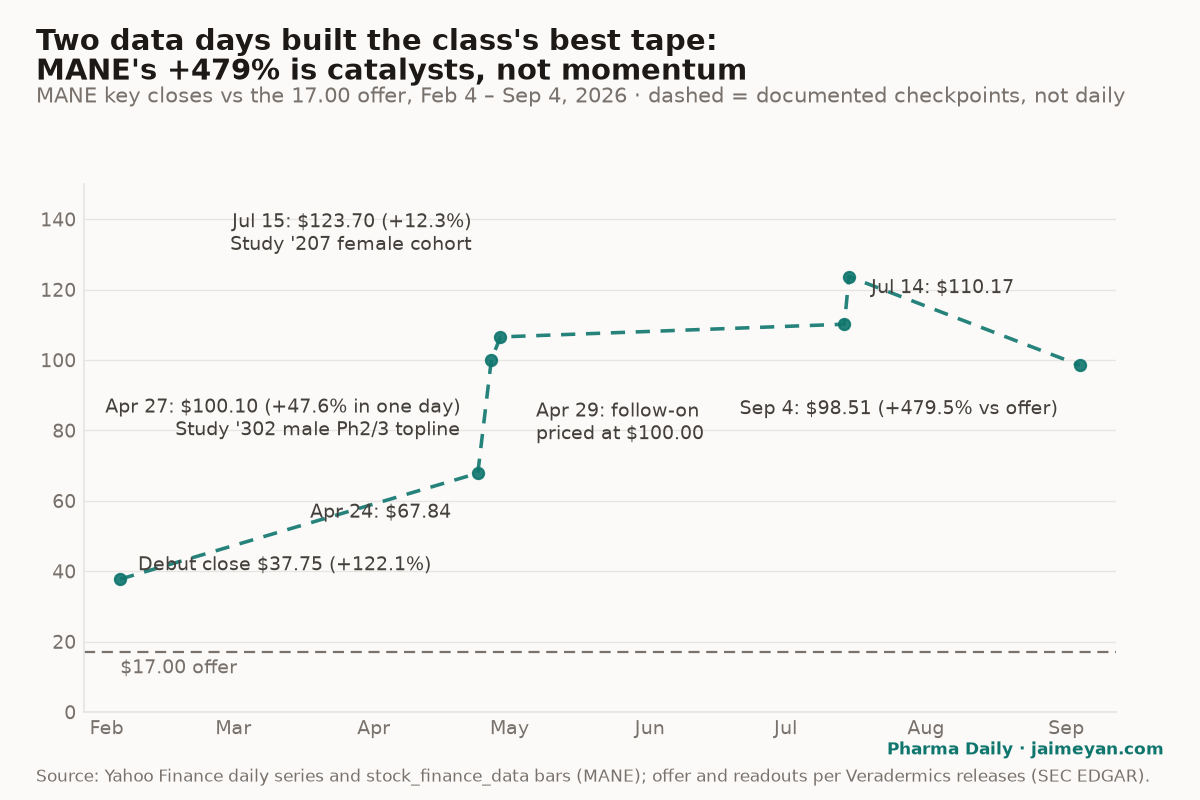
Figure 1: The +479% decomposes into the debut, two clinical data days, and long flat digestion — not a momentum grind. Documented closes per the Yahoo Finance daily series and the stock_finance_data feed; dashed segments connect documented checkpoints, not a daily series.
The post-run register deserves a note: the company filed a resale registration in August (424B3 effective August 14), and mid-August brought multiple Form 144s and 13D amendments — insiders selling into strength after the ~180-day IPO lockup expired. That is normal post-run behavior and is reported here as flow, not as a signal.
Cash is not a constraint: $819.9M of cash, equivalents, and marketable securities at June 30, a Q2 net loss of $23.5M on $18.6M of R&D, and guided funding into 2030 — through the Phase 3 readouts and a potential VDPHL01 launch.
What would change the story
- Study ‘304 male Phase 3 topline, 2H 2026 — the replication test of the +30–33 hairs/cm² Phase 2/3 result, and the gating item for an NDA.
- Study ‘306 female readout, 1H 2027 — the second indication leg.
- Insider flow — Form 144 selling is under way post-lockup; the rate matters more than the fact.
- Cardiac safety language — the whole franchise premise is that ER avoids minoxidil’s peak-exposure risk; any cardiac signal in the larger Phase 3 population is the bear case.
One Take
Veradermics is the proof case for the class bifurcation, and the useful lesson is when the market paid: not at the IPO (a +122% pop that could have been froth), but on April 27, when a disclosed, placebo-controlled number — +33.0 vs +7.3 hairs/cm² — let the market mark a single-asset Phase 3 story to $100 in one session and then buy $442M of follow-on at that level two days later. I read the post-July digestion ($123.70 → $98.51) as the tape correctly pricing the residual risk: one male Phase 3 between here and an NDA, on a drug class with a cardiac-safety question the ER formulation must keep answering. Conviction: moderate-high that MANE’s mark is binary on the 2H 2026 topline rather than on sector flow — the stock shrugged off the August insider-selling wave, which says the register is event-driven. What changes my mind: a ‘304 miss or a cardiac AESI signal (the fade template is already drawn: −14% the day after the female data), or conversely a clean replication, which hands the company a launch-funded balance sheet into 2030 and turns the IPO class’s best trade into its first commercial test.
Key takeaways
- Veradermics priced $294.8M (greenshoe included) at $17.00 on February 3 — almost exactly the class median check — and is the class’s best performer at +479.5% vs offer as of September 4.
- The run decomposes into disclosed events: +122.1% on debut, +47.6% on the April 27 male Phase 2/3 topline, +12.3% on the July 15 female-cohort Phase 2 data — then a three-month digestion of −20% from the peak.
- Eli Lilly held a non-binding anchor indication of up to 4.9% of post-offering shares; the greenshoe was fully exercised; a $442M follow-on priced at $100.00 twelve weeks later — 5.9x the offer.
- VDPHL01 is internally developed (no in-license; earliest patent expiry 2043): the class’s best tape belongs to its cleanest single-asset story.
- The next binary is the male Phase 3 (Study ‘304, NCT06972264), guided 2H 2026, with cash into 2030 removing financing risk before it.
FAQ
Is VDPHL01 approved?
No. It is a Phase 3-stage candidate: the male Phase 3 reads out in 2H 2026 and the female Phase 2/3 in 1H 2027. What is on record so far is a 519-patient male Phase 2/3 (+30.3/+33.0 hairs/cm² vs +7.3 placebo at Month 6, p<0.0001) and an open-label Phase 2’s female cohort (Study ‘207).
What actually drove the +479%?
Two disclosed clinical readouts (April 27 and July 15) plus a $442M follow-on at $100 that validated the new level — not a steady climb. The stock’s three big up-days account for most of the gain; since July 15 it is down ~20% from the peak.
How does this deal compare with the 2026 class?
At $294.8M with the greenshoe it is the class median raise to within $0.2M — and its +479.5% mark is the class maximum. The combination is the parent’s bifurcation thesis in one ticker: median-sized check, late-stage single asset, near-term readouts.
Sources
First-hand (filings and releases):
- Veradermics Announces Pricing of Upsized IPO (15,077,647 shares at $17.00) — Veradermics, 2026-02-03
- Veradermics S-1/A, January 28, 2026 (13.35M shares at $14–16) — SEC EDGAR
- Pricing FWP (Lilly anchor indication up to 4.9%) — SEC EDGAR
- Veradermics 424B4 final prospectus (pipeline; internal origin; patent 2043) — SEC EDGAR
- Study ‘302 topline release, April 27, 2026 (+30.3/+33.0 vs +7.3 hairs/cm², p<0.0001) — SEC EDGAR
- Study ‘207 female Phase 2 release, July 15, 2026 — SEC EDGAR
- Q1 2026 10-Q (full greenshoe exercise; $294.8M gross; net $269.1M) — SEC EDGAR
- Q2 2026 10-Q (follow-on; Montanova placement) and May 1 follow-on 8-K — SEC EDGAR
- Q2 2026 results release (cash + securities $819.9M; runway into 2030) — SEC EDGAR
- ClinicalTrials.gov: NCT06724614 (‘302) · NCT06972264 (‘304) · NCT07146022 (‘306) · NCT06527365 (‘207)
Aftermarket and context:
- The New Biotech IPO Class: Bigger, Later-Stage, and Judged Harder — Pharma Daily (parent analysis; class table and median)
- Veradermics locks in $256M IPO, shares spike — Fierce Pharma, 2026-02-05
- Baldness Biotech Veradermics Prices $256M IPO for Pivotal Tests of Pill for Hair Loss — MedCity News, 2026-02-04
Provenance: collected 2026-09-05. Filing figures from the EDGAR documents above; prices via the Yahoo Finance daily series for MANE (first-day close $37.75; Apr 24 $67.84 → Apr 27 $100.10; Jul 14 $110.17 → Jul 15 $123.70 → Jul 16 $105.83; Aug 28 $97.93) and the stock_finance_data feed (Sep 4 close $98.51, volume 363,236). Percentages vs the $17.00 offer are computed from those closes. The internal study-number↔NCT mapping is inferred from phase, population, and timing — the registry does not print Veradermics’ internal study numbers. All performance figures are marked to the September 4, 2026 close and will move with the market.