Kailera Therapeutics priced a then-record $625 million biotech IPO on April 16, 2026 — 39,062,500 shares at $16.00, the top of its $14–16 range, upsized roughly 17% from its amended filing — and closed at $718.8M gross after the underwriters exercised the full greenshoe. The stock popped +62.5% on its first day and has since given all of it back: $16.23 at the September 4 close, +1.4% versus offer.
TL;DR — Kailera (Nasdaq: KLRA) raised the 2026 class’s second-largest check on a single in-licensed franchise: four Hengrui-originated GLP-1 assets, led by ribupatide, a GLP-1/GIP dual agonist already in three global Phase 3 trials. The deal priced at the top of range with ~$225M of indicated anchor interest; Bain Capital entities later disclosed $159.4M of actual IPO purchases. The tape, however, round-tripped a +62.5% first-day pop to +1.4% as of the September 4 close — performance figures marked to that date; prices move daily. Caveat: the clinical case rests heavily on Hengrui-generated China data, and the company itself lists FDA acceptance of foreign data as a risk factor.
This is a per-company companion to our 2026 IPO class deep-dive, which named Kailera the class canary: the record check that the aftermarket could not hold. Parabilis took Kailera’s record eight weeks later — covered in the companion piece.
The asset: ribupatide, a Hengrui GLP-1/GIP agonist with China data and a 2028 readout ladder
Kailera’s entire pipeline is in-licensed from Jiangsu Hengrui under a May 2024 agreement: exclusive development and commercialization rights worldwide outside Greater China, plus a right of first refusal on certain additional Hengrui metabolic assets. Four clinical-stage candidates:
- Ribupatide (KAI-9531 / HRS9531), once-weekly injectable GLP-1/GIP dual agonist, the lead. Hengrui’s China data: 12 weeks at 8 mg produced a mean −23.6% weight reduction (efficacy estimand) versus −1.8% on placebo; a 48-week China Phase 3 at up to 6 mg showed −19.2% (efficacy estimand) versus −1.4%, with no plateau in either trial. Over 2,500 participants have been dosed. Kailera’s global Phase 3 KaiNETIC program is three trials — NCT07284875 (n≈2,340, obesity without diabetes), NCT07284901 (n=1,156, with type 2 diabetes), and NCT07284979 (n=1,200, BMI 35+, with an open-label semaglutide 2.4 mg comparator arm) — all recruiting, with topline results guided for 2028. A fourth Phase 3 in obesity with knee osteoarthritis (NCT07709910, n=382) is registered but not yet recruiting. A Phase 2b high-dose trial (up to 20 mg; NCT07458269, actual enrollment 264, active and no longer recruiting) has an estimated primary completion of May 2027.
- Oral ribupatide (KAI-9531-T), the same peptide as a once-daily tablet: Hengrui Phase 2 showed up to −12.1% at 26 weeks with low vomiting and nausea rates; global Phase 3 planned as early as H1 2027.
- KAI-7535 (HRS-7535), once-daily oral small-molecule GLP-1: Hengrui Phase 2 showed −9.5% (−8.1% placebo-adjusted) at week 36; Hengrui’s China Phase 3 (n=556) has topline anticipated in 2026; Kailera’s own Phase 2 (n≈320, up to 360 mg) started April 2026 with topline expected 2027.
- KAI-4729 (HRS-4729), GLP-1/GIP/glucagon tri-agonist: Phase 1 planned for 2026, topline expected 2027.
The license economics, per the S-1/A: Hengrui received a $100M non-refundable upfront, a $10M technology transfer fee, and 5,677,603 Series A-2 preferred shares (fair value ~$96.4M, 19.9% of the capital stock at issuance). Contingent consideration: up to $200M of clinical and regulatory milestones, up to $5.725B of commercial milestones, and tiered royalties from mid-single-digit to low-tens percentages of net sales. Of the roughly $6.1B headline, 96.6% is contingent.
The China-asset flow this deal belongs to is still running: our September 4 daily brief tracked Menarini paying $771M for European rights to Gan & Lee’s GLP-1, and one-third of 2025 licensing and collaboration capital went to Chinese companies, per Stifel via Ropes & Gray.
The deal: top of range, one upsize, anchors mostly confirmed
| Step | Shares | Price | Gross |
|---|---|---|---|
| S-1/A (Apr 13) | 33,333,334 | $14–16 | up to ~$533M |
| Priced (Apr 16) | 39,062,500 | $16.00 | $625.0M |
| Greenshoe exercised in full (closed Apr 20) | 44,921,875 | $16.00 | $718.8M |
Table 1: Kailera pricing steps per the pricing release and the closing release; range per the S-1/A. Net proceeds estimated at ~$662.1M with the full greenshoe, per the 424B4.
The syndicate was five joint bookrunners — J.P. Morgan, Jefferies, Leerink, TD Cowen, Evercore ISI — plus William Blair as lead manager. The S-1/A disclosed non-binding indications of up to ~$225M from existing stockholders affiliated with Bain Capital Private Equity, Bain Capital Life Sciences, and the Qatar Investment Authority. Post-IPO Schedule 13Ds confirm Bain entities bought $159.4M of the deal (8,398,438 and 1,562,500 shares); QIA’s actual purchase is not separately disclosed in any filing we found, so the residual ~$66M of the indication stays unverified.
Against the class: $625M at pricing is 2.1x the 2026 median of $295M and was, in April, the largest biotech IPO ever — passing Moderna’s 2018 record, per BioPharma Dive — before Parabilis repriced the record book in June. Kailera had raised $900M privately since its May 2024 inception (Bain Capital, RTW, Atlas, CPP Investments) per the S-1/A — BioPharma Dive’s IPO-day report puts the private funding at “more than $1 billion”; we use the filing’s figure — so the IPO took the disclosed equity raised above $1.6B in under two years.
The tape: the class canary, still hovering at issue
KLRA opened and closed its first session (April 17) at $26.00, +62.5%, on 8.1M shares — a market capitalization of roughly $3.2B, computed on the 123.7M shares outstanding immediately after pricing (the full greenshoe, which took the count to 129.5M, was only exercised at the April 20 closing). It never closed above that print. The decline was a grind, not a gap: ~$24–25 through late April, ~$19–23 through June, $21.99 on July 2, and $16.23 on September 4 — +1.4% versus the offer, on 98,468 shares traded that day.
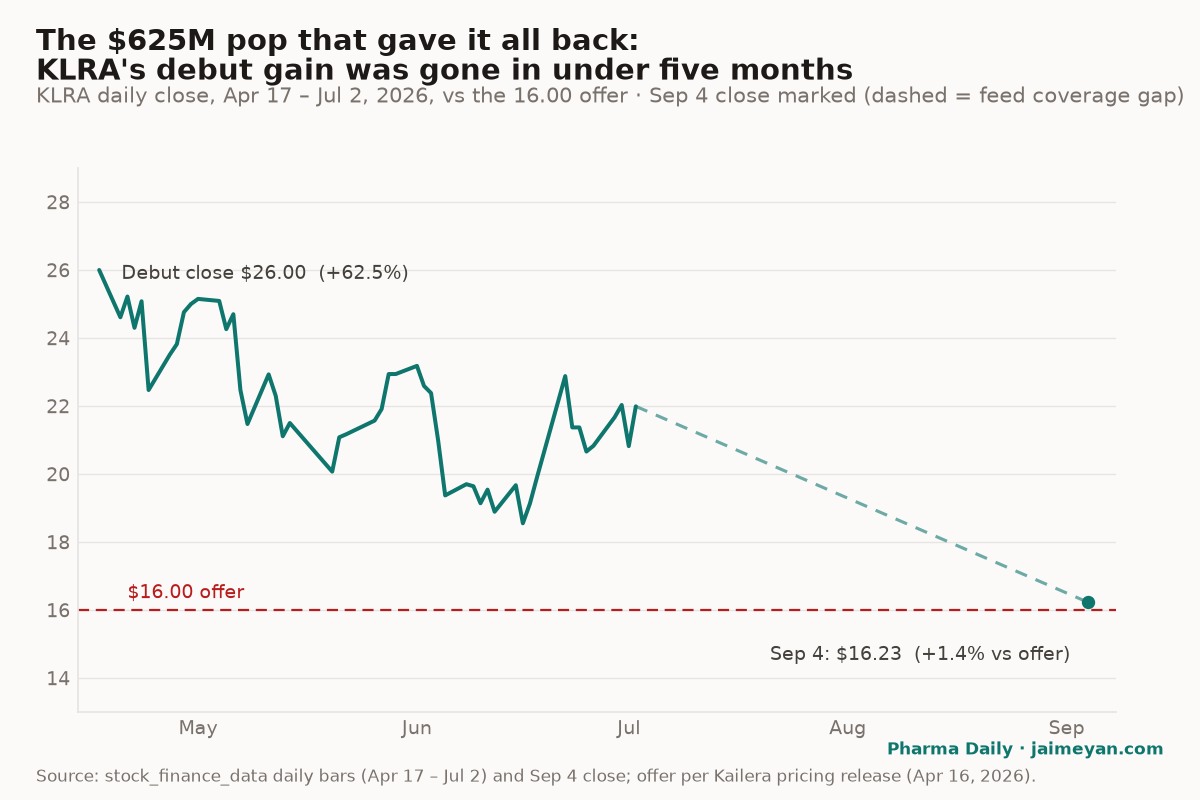
Figure 1: KLRA closed its debut +62.5% and has not closed above that print since — the aftermarket re-priced the record deal to roughly its offer in under five months. Daily closes Apr 17–Jul 2 per the stock_finance_data feed; Sep 4 close ($16.23) marked separately (feed gap Jul 3–Sep 3).
Our class piece framed the 2026 aftermarket as bifurcated: single-asset late-stage stories rewarded, platforms punished. Kailera complicates that finding. It is a late-stage, single-franchise company — the profile the tape supposedly rewards — and it sits at +1.4%. The difference the market appears to price: the data behind the franchise are Hengrui’s China trials, the rights are ex-China only, and the pivotal readouts are in 2028 while the cash runway is guided “into mid-2028” — $1.17B of cash, equivalents, and marketable securities at June 30 against a Q2 net loss of $111.3M ($101.1M of R&D, $70.6M of it on injectable ribupatide). The raise buys the company to the edge of its own readout ladder, not past it.
What would change the story
- Hengrui’s HRS-7535 China Phase 3 topline, anticipated 2026 — the nearest readout anywhere in the franchise, and it is the licensor’s trial, not Kailera’s.
- Phase 2b high-dose ribupatide topline, guided 2027 (NCT07458269, primary completion estimated May 2027) — the test of whether doses above 6 mg widen the gap to tirzepatide-class benchmarks.
- Oral ribupatide global Phase 3 start, guided as early as H1 2027.
- KaiNETIC toplines, guided 2028 — and the financing question between here and there, given a mid-2028 runway.
- FDA’s posture on Hengrui-generated data, an explicit risk factor in the filing.
One Take
The round-trip is not the market souring on obesity — it is the market declining to pay a launch-day multiple for in-licensed China data with a 2028 payoff, and I read +1.4% as a floor set by the syndicate rather than a verdict on ribupatide. The structure tells the story: anchors indicated ~$225M of a $625M deal, the book was upsized at the top of range, and then the aftermarket spent five months discovering that the marginal buyer already owned the deal at $16. What re-rates the stock is not class beta but the 2026–2027 data ladder — Hengrui’s HRS-7535 Phase 3 this year, the high-dose Phase 2b next May — because the pivotal trials are too far out to underwrite and the runway (“into mid-2028”) ends before the KaiNETIC toplines begin. Conviction: moderate that KLRA’s mark is data-event-driven from here. Three falsifiers: a close below $16 (the parent’s canary test), a miss or delay on the HRS-7535 China topline, or any FDA signal that Hengrui-generated data will not support a U.S. filing.
Key takeaways
- Kailera priced $625M at the top of range on April 16 (upsized ~17%) and closed at $718.8M gross with a full greenshoe — 2.1x the 2026 class median, and a biotech IPO record for the eight weeks until Parabilis repriced it.
- The pipeline is wholly in-licensed from Hengrui: $100M upfront plus ~$96.4M in equity (19.9% at issuance), with 96.6% of the ~$6.1B headline contingent on milestones.
- First-day +62.5% round-tripped to +1.4% by September 4 — the weakest hold among the class’s large single-asset deals, despite the profile the bifurcated tape supposedly rewards.
- Guided cash runway (“into mid-2028”) ends before the guided KaiNETIC Phase 3 toplines (2028): the record raise does not fund the company through its own pivotal data.
- The nearest catalyst is not even Kailera’s trial: Hengrui’s China Phase 3 of HRS-7535 has topline anticipated in 2026.
FAQ
Is Kailera just Hengrui’s U.S. arm?
Legally no, economically close. Kailera holds exclusive rights to the four candidates outside Greater China and paid $100M cash, a $10M transfer fee, and 19.9% of its pre-IPO capital stock for them; Hengrui keeps Greater China and collects up to $5.9B in milestones plus royalties. Kailera runs the global trials; the dosing and efficacy evidence base is Hengrui’s.
Why did the +62.5% pop disappear?
We report the tape rather than explain it: the stock never closed above its $26.00 debut print and slid to +1.4% over five months on thinning volume. What the filings support as context: the ~$225M anchor indication — all from existing holders — covered roughly a third of the $625M deal, the pivotal readouts are 2028, and the cash runway ends mid-2028.
What is the next KLRA catalyst?
Hengrui’s China Phase 3 topline for HRS-7535, anticipated in 2026 — a licensor trial on a Kailera-licensed asset. Kailera’s own nearest readout is the high-dose ribupatide Phase 2b, guided 2027 (NCT07458269).
Sources
First-hand (filings and registry):
- Kailera Announces Pricing of Initial Public Offering (39,062,500 shares at $16.00) — GlobeNewswire, 2026-04-16
- Kailera Announces Closing of IPO and Full Exercise of Underwriters’ Option ($718.8M gross) — Kailera Therapeutics, 2026-04-20
- Kailera S-1/A, April 13, 2026 (range $14–16; Hengrui license terms; pipeline data) — SEC EDGAR
- Kailera 424B4 final prospectus (net proceeds estimate) — SEC EDGAR
- Kailera Q2 2026 10-Q (cash + securities $1,171.8M; runway into mid-2028; Q2 net loss $111.3M) — SEC EDGAR
- Schedule 13D — Bain Capital entity, 1,562,500 shares ($25.0M) and Schedule 13D — second Bain entity, 8,398,438 shares ($134.4M) — SEC EDGAR
- ClinicalTrials.gov: NCT07284875 · NCT07284901 · NCT07284979 · NCT07709910 · NCT07458269 (Phase 2b high-dose)
Aftermarket and context:
- The New Biotech IPO Class: Bigger, Later-Stage, and Judged Harder — Pharma Daily (parent analysis; class table and median)
- Kailera nets $625M in one of biotech’s biggest-ever IPOs — BioPharma Dive, 2026-04-16
- Pharma Daily — September 4, 2026 (Menarini ← Gan & Lee $771M GLP-1 deal) — Pharma Daily
- Biotech IPO Tracker 2026 — BioBucks (Aug 28 class marks)
Provenance: collected 2026-09-05. Filing figures from the EDGAR documents above; daily closes April 17–July 2 and the September 4 close ($16.23, +3.11% on the day, volume 98,468) via the stock_finance_data market feed; the July 3–September 3 stretch is outside that feed’s coverage and is not charted or quoted. The first-day close of $26.00 additionally cross-checks against the next session’s reported open and change. Percentages vs the $16.00 offer are computed from those closes. QIA’s IPO purchase is not separately disclosed; we report the ~$225M indication and Bain’s confirmed $159.4M only. All performance figures are marked to the September 4, 2026 close and will move with the market.