Eikon Therapeutics priced an upsized $381 million IPO at the top of its range on February 4, 2026 — 21,177,600 shares at $18.00 — and closed its first session down 16.7% at $15.00. Seven months later, without a single negative clinical event disclosed, the stock sits at $10.86 as of the September 4 close, −39.7% versus offer.
TL;DR — Eikon (Nasdaq: EIKN) upsized its base deal 20% (17.65M → 21.18M shares), priced at the $18 top of range, and still broke on debut; the underwriters’ 15% greenshoe was never exercised, per the Q2 10-Q share count. The decline was a gradual March–April bleed, not a catalyst event: no trial failure, delay, or financing 8-K exists — and the August 3 lockup expiry did not accelerate it. Performance figures are marked to the September 4, 2026 close; prices move daily. Caveat: the company’s nearest value event, the EIK1001 melanoma registrational interim, is guided for H2 2026 — the entire thesis reprices on that readout.
This is a per-company companion to our 2026 IPO class deep-dive, which found the aftermarket punishing platform narratives. Eikon is the cleanest test case: the largest check of its week, the most decorated platform pedigree in the class, and the worst tape.
The asset: a registrational TLR7/8 agonist rented from the licensor, a platform still proving itself
Eikon’s lead asset is EIK1001, a TLR7/8 dual agonist in-licensed from Seven and Eight Biotherapeutics (where it was BDB001). At pricing it was in a global registrational Phase 2/3 with pembrolizumab in first-line advanced melanoma (NCT06697301, ~740 patients, recruiting), with the first interim analysis guided for H2 2026. A second registrational Phase 2/3 in NSCLC (EIK1001 + pembrolizumab + chemotherapy; NCT07365319, 750 patients) was in site selection at IPO and is now recruiting, alongside the smaller Phase 2 TeLuRide-005 (NCT06246110, 70 patients, active-not-recruiting, primary completion December 2026).
The rest of the pipeline is earlier and mostly rented: EIK1003 (selective PARP1 inhibitor) and EIK1004 (brain-penetrant PARP1), both Phase 1/2, both in-licensed from Shanghai’s Impact Therapeutics; EIK1005, a WRN helicase inhibitor for MSI-high tumors, is the first program derived from Eikon’s own discovery platform. That platform — single-molecule tracking built on co-founder Eric Betzig’s Nobel-winning super-resolution microscopy, with Robert Tjian co-founding and ex-Merck R&D chief Roger Perlmutter as CEO — is what the $381M was supposed to underwrite. The S-1/A discloses aggregate licensing obligations of up to $630M in development and regulatory milestones, up to $1.1B in sales milestones, and high-single-digit to low-teen royalties: the pipeline’s economics are shared with licensors even if the science works.
Eikon had raised more than $1.1B privately before the IPO (The Column Group, Lux Capital, Catalyst4 among the backers) — the largest private war chest in the 2026 class relative to deal size.
The deal: upsized, top of range, and the greenshoe nobody took
| Step | Shares | Price | Gross |
|---|---|---|---|
| Marketed range (S-1/A, Jan 28) | 17,648,000 | $16–18 | $282–318M |
| Priced (Feb 4) — upsized ~20% | 21,177,600 | $18.00 | $381.2M |
| Greenshoe (15%, 3,176,640 shares) | not exercised | — | $0 |
Table 1: Eikon pricing steps per the S-1/A, the pricing release, and the Q2 2026 10-Q (share count showing no greenshoe exercise). Net proceeds were $348.1M after $33.1M of underwriting discounts, commissions, and other offering costs.
The syndicate — J.P. Morgan, Morgan Stanley, BofA, Cantor, Mizuho — read demand as strong enough to upsize and price at the top. The aftermarket disagreed within six hours. The unexercised greenshoe is the deal’s quiet tell: in a class where Kailera, Parabilis, and Veradermics all saw full exercise, Eikon’s underwriters never took their 15% option, because the stock spent its entire first month below the $18 offer. At $381M gross the deal was 1.3x the class median of $295M and, per Fierce Biotech, the largest biotech IPO since 2024 — overtaking the $318M Aktis had priced the month before.
No anchor or cornerstone indications were disclosed in the S-1/A — a contrast with Kailera’s ~$225M of insider indications that we noted in its companion piece.
The tape: a slow bleed, not a break
EIKN opened at $17.05 on February 5 (−5.3%) and closed at $15.00. It never traded above the $18 offer — even the intraday peak, $17.40, printed on debut day; the highest close is $16.26 (February 18). From $15.72 on February 17 the stock ground down to $8.56 by April 28 (a session that also printed the intraday trough, $7.90), including single-day drops of 10.6% (March 12) and 9.7%/9.5% (April 24/27). The lowest close was $8.36 on June 10. Then, notably, it drifted up: $9.15 on August 3 — the day the 180-day lockup expired and 32.9M shares became sale-eligible — and $10.86 by September 4.
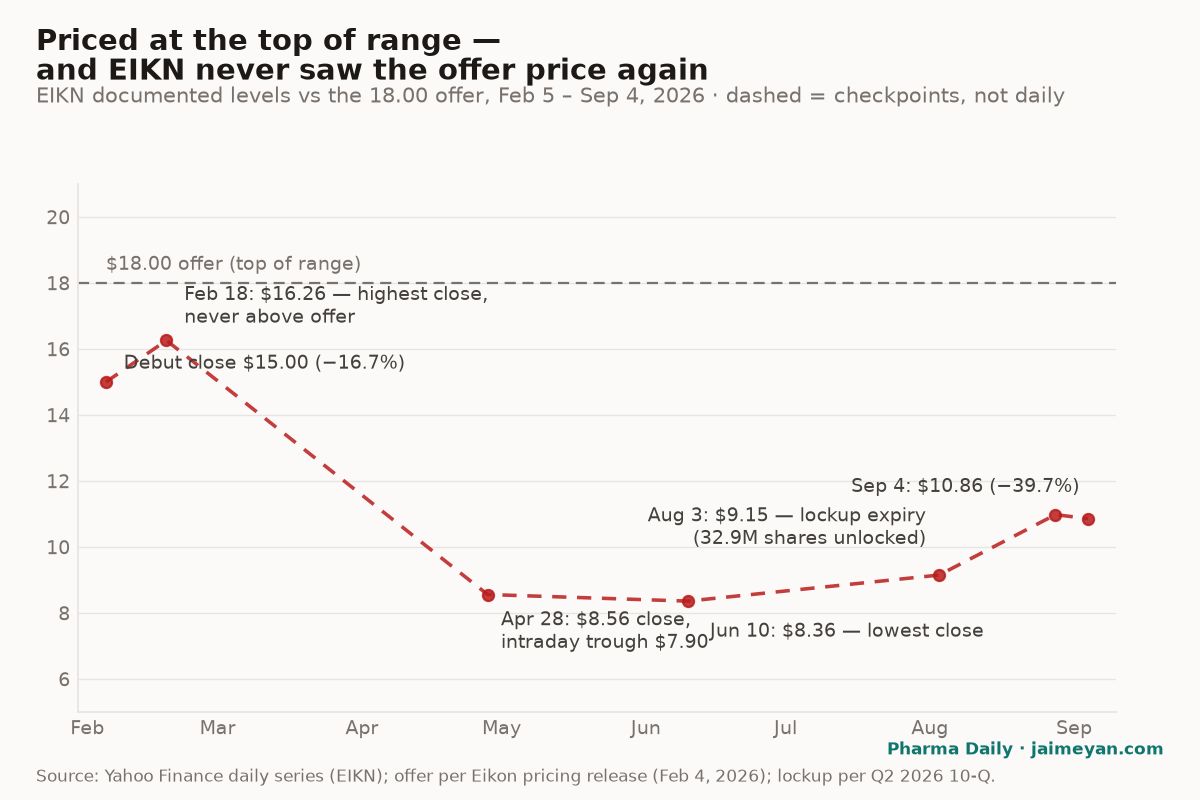
Figure 1: Eikon’s decline was a repricing, not an event — the lockup expiry (Aug 3) marks a local bottom, not a break. Key levels per the Yahoo Finance daily series; dashed segments connect documented closes, not a full daily path.
We checked the filings for a cause and found none: the post-IPO 8-K log on the EDGAR filing index is routine — earnings releases, two company-update decks, one director appointment — with no trial failure, delay, or safety disclosure. The one governance item that did land: on July 31, Leon Chen of The Column Group and Joshua Wolfe of Lux Capital resigned from the board (8-K filed August 3) — the two signature venture backers stepping off within days of the lockup expiry, at what turned out to be the bottom of the tape.
The balance sheet is not the problem: $531.2M of cash, equivalents, and marketable securities at June 30, a Q2 net loss of $88.4M on $75.5M of R&D, and guided runway into H2 2027 — enough to reach the melanoma interim without raising.
What would change the story
- The EIK1001 melanoma interim, H2 2026 — the single binary that reprices the stock in either direction; a registrational trial, so a hit is a filing path, not just a data point.
- TeLuRide-005 primary completion, December 2026 (NCT06246110) — the NSCLC signal check.
- EIK1005 clinical progress — the first internally derived program is the platform’s proof-of-work; without it, the discovery engine remains a pitch.
- Insider behavior post-lockup — the Column/Lux board exits are done; any Form 4 selling from the 32.9M unlocked shares is the next tell.
One Take
Eikon is the control group for this class’s bifurcation: same week as Veradermics, bigger check, comparable stage on paper — and the opposite outcome, −39.7% versus +479.5% (both as of the September 4 close), with no adverse event to explain it. I read the break as the market repricing structure, not science: an in-licensed lead asset whose pivotal interim was nine months away at pricing, a platform whose first internal molecule is still in Phase 1/2, no disclosed anchors, and $1.7B of milestone obligations owed to licensors on the rented parts of the pipeline. The syndicate’s upsize at the top of range looks, with hindsight, like demand manufactured by allocation — the greenshoe that nobody exercised is the receipt. Conviction: moderate that EIKN stays range-bound until the melanoma interim, because nothing between now and H2 2026 supplies new information at the scale the valuation needs. What changes my mind: the interim itself (a hit re-rates the platform narrative instantly; a miss on a registrational trial is a different company), or insider buying from the funds that just left the board — which would say the smart money marks the platform lower than $10.86 and still wants in.
Key takeaways
- Eikon upsized ~20% and priced at the $18 top of range on February 4, then closed its debut at $15.00 (−16.7%); the 15% greenshoe was never exercised — the only non-exercise we have documented in this series, against full exercise at Kailera, Parabilis, and Veradermics.
- The stock never traded above its offer (intraday peak $17.40 on debut; highest close $16.26 on February 18) and printed its intraday trough at $7.90 on April 28; the August 3 lockup expiry of 32.9M shares marked a local floor, not a break.
- No negative catalyst exists in the record: every post-IPO 8-K is routine; the decline was a gradual repricing of a platform story with an in-licensed lead and a distant (H2 2026) binary.
- Column Group’s Leon Chen and Lux’s Joshua Wolfe resigned from the board effective July 31 — days before the lockup expiry and near the tape’s low.
- Cash of $531.2M funds operations into H2 2027: the runway reaches the melanoma interim; the valuation question is the readout, not the balance sheet.
FAQ
Why did Eikon’s stock fall without bad news?
There is no adverse clinical or financial disclosure in any post-IPO filing — we checked. The decline is a gradual repricing of structure: a platform narrative, an in-licensed lead asset, and a pivotal interim nine months out at pricing, in a market that the class analysis showed rewarding only de-risked single assets.
Is an unexercised greenshoe unusual?
In this class, yes. Kailera and Parabilis both saw full exercise on their record deals; Eikon’s underwriters let a 15% option lapse because the stock traded below the offer price for its entire first month. It is the cleanest public signal that the deal was over-placed at $18.
What reprices EIKN?
The EIK1001 first-line melanoma registrational interim, guided for H2 2026 (NCT06697301, ~740 patients). TeLuRide-005 in NSCLC completes in December 2026 but is a 70-patient Phase 2 — signal, not verdict.
Sources
First-hand (filings and registry):
- Eikon Announces Pricing of Upsized Initial Public Offering (21,177,600 shares at $18.00) — Eikon Therapeutics, 2026-02-04
- Eikon S-1/A, January 28, 2026 (range $16–18; pipeline; licensing obligations; platform) — SEC EDGAR
- Eikon 424B4 final prospectus — SEC EDGAR
- Eikon Q2 2026 10-Q (no greenshoe exercise; 32.9M shares unlocked Aug 3) — SEC EDGAR
- Eikon Q2 2026 results release (cash $531.2M; net loss $88.4M; runway into H2 2027) — SEC EDGAR
- 8-K filed August 3, 2026 (Chen and Wolfe board resignations, effective July 31) — SEC EDGAR
- Eikon filing index (full post-IPO 8-K log) — SEC EDGAR
- ClinicalTrials.gov: NCT06697301 (1L melanoma registrational) · NCT07365319 (NSCLC registrational) · NCT06246110 (TeLuRide-005)
Aftermarket and context:
- The New Biotech IPO Class: Bigger, Later-Stage, and Judged Harder — Pharma Daily (parent analysis; class table and median)
- Eikon Therapeutics nets a $381M IPO amid burst of biotech offerings — BioPharma Dive, 2026-02-04
- Eikon’s upsized $381M Nasdaq listing marks largest biotech IPO since 2024 — Fierce Biotech, 2026-02-05
- Eikon’s IPO splash fades as shares tumble on debut — The Pharma Letter, 2026-02-06
- Six Months Later: Priced for Perfection, Punished by Reality — Smartkarma, 2026-08-03
Provenance: collected 2026-09-05. Filing figures from the EDGAR documents above; price history (first-day open $17.05 / close $15.00, post-IPO high $16.26 on Feb 18, low $8.36 on Jun 10, Aug 3 close $9.15, Aug 28 close $10.98, Sep 4 close $10.86) via the Yahoo Finance chart API for EIKN. Percentages vs the $18.00 offer are computed from those closes. No anchor-investor disclosure exists in the S-1/A; we say so rather than infer. We found no adverse clinical disclosure in any post-IPO filing — the absence is itself reported above. All performance figures are marked to the September 4, 2026 close and will move with the market.