Seaport Therapeutics priced an upsized IPO at the top of its range on April 30, 2026 — 14,160,000 shares at $18.00 for $254.9 million gross, $260.0M after the greenshoe was partially exercised — and closed its first session on May 1 up 10.2%. As of the September 4 close the stock trades at $24.86, +38.1% versus offer.
TL;DR — Seaport (Nasdaq: SPTX — the class table left the ticker unverified; confirmed here from the 424B4) is PureTech’s neuropsychiatry spinout built on the Glyph lymphatic-targeting prodrug platform: three assets, the lead an oral prodrug of allopregnanolone in a Phase 2b depression trial with topline due 1H 2027. The tape broke the stock below offer in its first two weeks, then re-rated it on human pharmacology data (GlyphAgo’s 6.8x bioavailability gain) and a $427.3M cash-and-investments balance with runway guided into 2029. Performance figures are marked to the September 4 close; prices move daily. Caveat: the +12.1% move on August 26 — the second-largest single-day gain of the aftermarket — has no disclosed catalyst in any filing or company release we found.
This is a per-company companion to our 2026 IPO class deep-dive, which found the aftermarket rewarding late-stage single-asset stories and punishing platform narratives. Seaport is the stress test of that rule: a genuine platform story that the tape did not punish.
The asset: prodrugs that ride the lymphatics, with a mechanism that already has an FDA precedent
Seaport’s entire stack sits on Glyph, a lymphatic-targeting prodrug technology that bypasses first-pass metabolism and creates new composition-of-matter IP. One correction to the parent table: it carried the $255M pricing headline and left the ticker blank; final gross was $260.0M after the partial greenshoe. The correct lineage is that PureTech in-licensed the Glyph IP from Monash University (exclusive, royalty-bearing; development milestones up to $1.075M and commercial milestones up to $7.25M per product for the first three products) and transferred the assets to Seaport — incorporated April 1, 2024 — via an Asset Transfer Agreement entered into in April 2024, in exchange for 40 million Series A-1 shares plus milestones of up to $10M on the first product and $5M per subsequent product, tiered royalties of 3–5% of net sales, and a 5–7.5% sublicense income share for CNS indications.
The lead is GlyphAllo (SPT-300), an oral Glyphed prodrug of allopregnanolone — the endogenous GABA-A positive allosteric modulator neurosteroid — for major depressive disorder with or without anxious distress. The mechanism carries unusual validation for a platform company: IV allopregnanolone (Sage’s brexanolone) is approved in postpartum depression with statistically significant HAMD-17 change at 60 hours in two trials, and zuranolone met its primary endpoint in five of six MDD trials. Seaport’s own Phase 1 in Australia (n=99) showed therapeutically relevant exposures — AUCinf of 6.6 ng·hr/mL per mg dosed versus 0.7 for oral unmodified allopregnanolone — and a Phase 2a (n=80, randomized, placebo-controlled, TSST stress model in healthy volunteers) showed initial proof-of-concept on an objective stress biomarker with no severe or serious adverse events. The pivotal plan is BUOY-1, a global randomized double-blind placebo-controlled Phase 2b of roughly 360 patients dosed six weeks with HAMD-17 change at week 6 as the primary endpoint — “registration-enabling,” initiated July 2025, topline expected 1H 2027 (NCT07065240; the 360 enrollment is the registry’s estimate, recruiting across 62 sites; an open-label extension, NCT07161700, is enrolling by invitation). A Phase 1 driving-simulation trial of evening-dosed GlyphAllo reads out in 2H 2026.
Behind it: GlyphAgo (SPT-320), a Glyphed prodrug of agomelatine for generalized anxiety disorder, where April 2026 Phase 1 topline showed a 6.8x bioavailability increase versus unmodified agomelatine with 10x lower PK variability, and June MAD data achieved therapeutic exposures at doses projected to avoid the liver-enzyme elevations that limit the parent drug — Phase 2a proof-of-pharmacology starts 2H 2026 with data in early 2028, and a Phase 2b in GAD starts 1H 2027. Third is Glyph2BLSD (SPT-348), a preclinical non-hallucinogenic 2-bromo-LSD “neuroplastogen” with first-in-human-enabling studies due by year-end 2027. Private capital in was $326.1M gross ($100.1M Series A-2 at $3.80 in April 2024; $226.0M Series B at $4.75 in October/November 2024), and the post-IPO register remains concentrated: PureTech LYT held 31.5% at the close per the 424B4 (31.2% per its June 30 13G), with Sofinnova and Third Rock each above 5% per the 424B4, and ARCH (11.9%) and General Atlantic (11.5%) per their 13Ds.
The deal: 20% upsized at the top, anchors confirmed by 13D — but only 13.5% of the shoe
| Step | Shares | Price | Gross |
|---|---|---|---|
| Marketed range (S-1/A, Apr 27) | 11,800,000 | $16–18 | $189–212M |
| Priced (Apr 30) — top of range, upsized +20% | 14,160,000 | $18.00 | $254.9M |
| Final with partial greenshoe (per Q2 10-Q) | 14,446,658 | $18.00 | $260.0M |
Table 1: Seaport pricing steps per the S-1/A, the pricing release, and the 424B4; final share count and net proceeds of ~$238.4M per the Q2 2026 10-Q IPO note (the 424B4’s ~$233.9M net figure was the pre-shoe estimate). A second correction to the parent table: “$255M gross” was the pricing figure; final gross is $260.0M after the partial shoe.
The deal grew 20% in shares between the April 27 amendment and pricing, at the top of the range, with an upgraded listing to the Nasdaq Global Select Market and a five-bank syndicate (Goldman Sachs, J.P. Morgan, Leerink, Citigroup, Stifel). Anchor indications converted into actual buying, confirmed by post-IPO 13Ds rather than the non-binding prospectus language: General Atlantic, which had indicated up to $50M, bought 2,750,000 shares ($49.5M) in the offering and held 6.1 million shares (11.5%) after; ARCH Venture Fund XII bought 1,100,000 shares ($19.8M) for 6.3 million (11.9%) post-IPO. The soft spot: the underwriters exercised only 286,658 of the 2,124,000-share greenshoe — 13.5% — a quiet tell that aftermarket demand in the first 30 days did not support the full option. At $260.0M final gross the deal is 0.88x the class median of $295M; it priced the same week as Hemab’s $301.5M, the pair BioPharma Dive tallied at a combined $556.4M.
The tape: underwater for two weeks, then re-rated on pharmacology, not narrative
SPTX closed its May 1 debut at $19.84, +10.2% versus offer — several outlets reported “+17%,” but that was the intraday pop off the $21.00 open, not the close. The stock then gave it all back: $17.00 on the May 4 closing day and a lowest close of $15.25 on May 11, −15.3% versus offer. The recovery came on dated disclosures. The June 8 8-K carrying Q1 results plus new GlyphAgo MAD data was followed by a +9.0% session on June 9 to $17.66; the aftermarket’s largest single-day gain, +16.6% on July 8 ($18.23 to $21.26), likewise maps to no dated company disclosure. The August 3 Q2 print — cash, cash equivalents and investments of $427.3M at June 30, runway guided into 2029 — preceded closes of $20.65 and $21.43 on August 3–4. Then the anomaly: +12.1% on August 26 to the highest close of $27.84, with no company filing or press release that day that we could find; we label that catalyst unidentified rather than invent one. The stock gave back 8.4% to $24.04 on August 28 and closed September 4 at $24.86, +38.1% versus offer.
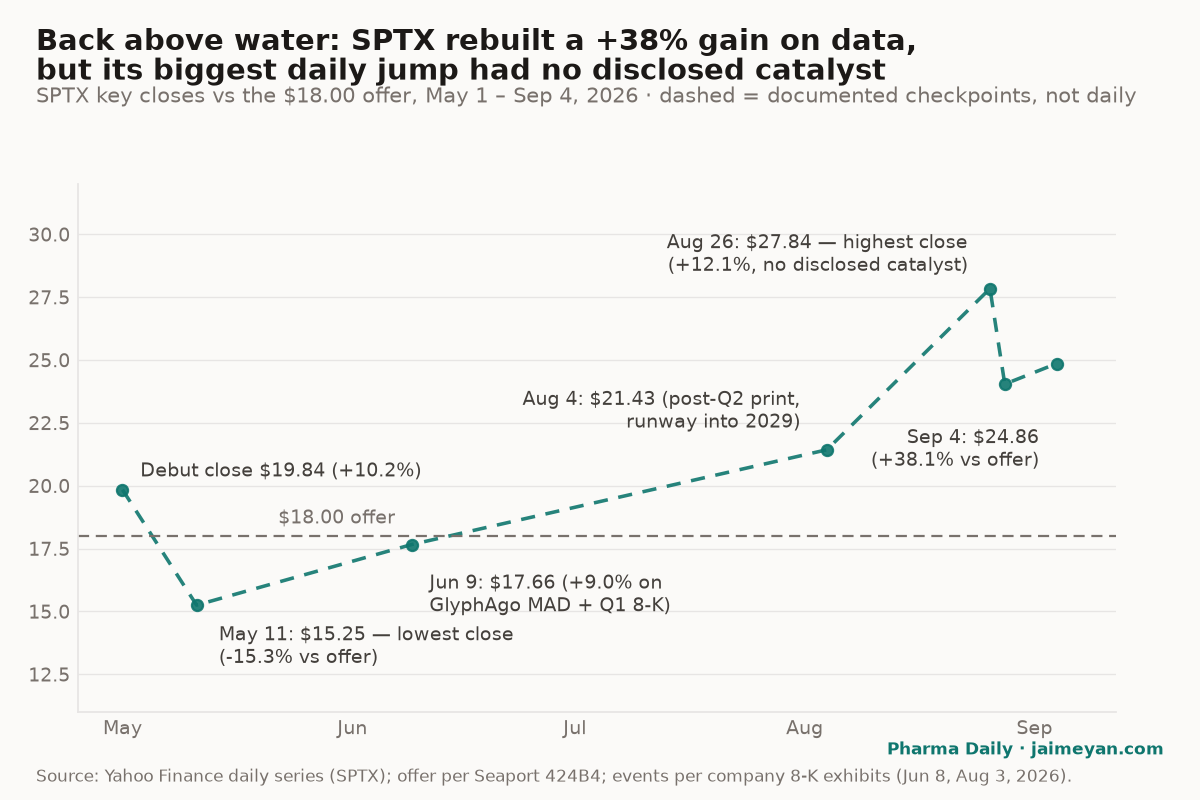
Figure 1: SPTX sank to −15.3% versus offer within two weeks of pricing, then rebuilt on GlyphAgo data and the Q2 print; the August 26 gain (+12.1%, the aftermarket’s second-largest single-day move) has no disclosed catalyst in EDGAR or company releases. Documented closes per the Yahoo Finance daily series; dashed segments connect documented checkpoints, not a daily series.
Against the class bifurcation: Seaport is the closest thing the 2026 class has to a platform story that worked — three assets on one prodrug engine, nothing pivotal-stage — and yet it did not trade like Eikon or Generate. The refinement is in how it got paid: the two dated re-rates followed human pharmacology numbers (a 6.8x exposure gain, a 10x variability reduction) and a runway extension, not platform language, and the stock first had to survive two weeks below water. Compare Avalyn’s +63.8% debut: the tape paid the reformulation story immediately and the prodrug platform only after it produced data.
What would change the story
- BUOY-1 topline, 1H 2027 (NCT07065240) — the make-or-break HAMD-17 readout in MDD; registry enrollment (360) and the March 2027 primary completion are estimates.
- Driving-simulation topline, 2H 2026 — next-morning impairment is the practical safety question for an evening-dosed neurosteroid; a bad result lands before BUOY-1 does.
- GlyphAgo Phase 2a start (2H 2026) and data (early 2028) — the second asset is what separates “platform” from “single-asset” in how the market prices this name.
- PureTech overhang — a 31.2% holder with milestones and 3–5% royalties coming back to it; any sell-down or monetization is a register event worth tracking via 13D/G amendments.
One Take
Seaport refines the class rule rather than breaking it: the tape did not punish this platform story, but it also did not pay for it until the platform produced human numbers — the stock traded below offer until GlyphAgo’s Phase 1 data and a runway into 2029 gave the Glyph engine a pharmacological receipt. What Seaport has over the punished platform names is that its lead mechanism is not a narrative: allopregnanolone pharmacology already carries an approval (brexanolone) and a five-of-six MDD endpoint record (zuranolone), so BUOY-1 is a translation bet on an oral prodrug of a validated pathway, not a biology bet. The offsetting risk is the indication itself — MDD placebo response has killed better-validated mechanisms than this one — and the +38.1% mark, built partly on an unexplained August 26 jump, embeds more confidence in a 360-patient Phase 2b than the disclosed evidence (an n=99 Phase 1 and a stress-model Phase 2a in healthy volunteers) strictly supports. Conviction: moderate that SPTX trades as a BUOY-1 clock into 1H 2027, with the 2H 2026 driving-simulation readout as the first real gap risk. Falsifiers: a BUOY-1 enrollment or timeline slip against the registry’s March 2027 estimate, any next-morning impairment signal, or a raise before the guided 2029 runway — the last would say management prices the pivotal program’s cost higher than the market does.
Key takeaways
- Seaport priced 14.16M shares at the $18.00 top of range on April 30 (upsized 20%) and closed at $260.0M gross after just 13.5% of the greenshoe was exercised; net proceeds ~$238.4M per the Q2 10-Q; final gross is 0.88x the class median of $295M.
- The tape: +10.2% debut close, lowest close $15.25 on May 11 (−15.3% vs offer), highest close $27.84 on August 26 (on no disclosed catalyst), +38.1% vs offer as of the September 4 close.
- The platform is Glyph, a lymphatic-targeting prodrug engine in-licensed from Monash University and transferred from PureTech; PureTech retains 31.2% plus milestones and 3–5% royalties.
- Anchor indications converted: General Atlantic bought ~$49.5M and ARCH ~$19.8M in the offering per post-IPO 13Ds, holding 11.5% and 11.9% respectively.
- The lead asset GlyphAllo is an oral prodrug of an already-validated neurosteroid mechanism, with the registration-enabling BUOY-1 Phase 2b topline due 1H 2027 and $427.3M of cash, cash equivalents and investments (June 30) guided to fund operations into 2029.
FAQ
Is Seaport’s drug licensed from Sage or Biogen?
No. GlyphAllo (SPT-300) is Seaport’s own oral prodrug of allopregnanolone, built on Glyph technology in-licensed from Monash University and transferred from PureTech; brexanolone and zuranolone appear in the prospectus only as mechanism validation, and no licensing relationship with Sage or Biogen is disclosed.
Why did a pre-pivotal platform company trade above offer when others broke?
Because the re-rates were tied to human data and cash, not narrative: the stock was below offer until the June GlyphAgo MAD data (6.8x bioavailability, 10x lower PK variability) and the August Q2 print (cash and investments $427.3M, runway into 2029). It is still the exception in a class where most platform stories traded down from pricing.
What is the next SPTX catalyst?
The GlyphAllo driving-simulation topline in 2H 2026, then the BUOY-1 Phase 2b topline in MDD guided for 1H 2027 (NCT07065240); GlyphAgo’s Phase 2a starts in 2H 2026 with data in early 2028.
Sources
First-hand (filings, releases, registry):
- Seaport 424B4 final prospectus (pipeline; Glyph/Monash/PureTech agreements; principal stockholders; General Atlantic indication; net proceeds estimate) — SEC EDGAR, 2026-04-30
- Seaport S-1/A, April 27, 2026 (11.8M shares at $16–18) and EDGAR submissions history (DRS 2025-11-21; S-1 2026-04-10; EFFECT 2026-04-30) — SEC EDGAR
- Seaport Announces Pricing of Upsized IPO (14,160,000 shares at $18.00; $254.88M gross) — Business Wire, 2026-04-30
- PureTech release: trading began May 1, offering closed May 4, 2026 and 8-K, May 4, 2026 (charter/bylaws at close) — SEC EDGAR
- Seaport Q2 2026 10-Q (final shares 14,446,658; net proceeds ~$238.4M; cash+investments $427.3M; Q2 net loss $62.6M; runway into 2029) — SEC EDGAR, filed 2026-08-03
- Q1 2026 results 8-K exhibit, June 8, 2026 (GlyphAgo MAD data; gross proceeds $260.0M) and Q2 2026 results 8-K, August 3, 2026 — SEC EDGAR
- Q2 2026 results release (driving-simulation topline 2H 2026; GlyphAgo Phase 2a/2b timing; BUOY-1 topline 1H 2027) — Seaport IR
- Post-IPO ownership: General Atlantic 13D (2.75M shares bought in offering; 6.1M total, 11.5%) · ARCH Venture Fund XII 13D (1.1M bought; 6.29M total, 11.9%) · Goldman Sachs 13G (5.5%, event date 2026-05-06) · PureTech 13G (31.2% as of Jun 30) — SEC EDGAR
- ClinicalTrials.gov: NCT07065240 (BUOY-1) · NCT07161700 (open-label extension) · sponsor query (GlyphAgo Phase 1 and driving trial not registered under Seaport; Australia-run studies)
Aftermarket and context:
- The New Biotech IPO Class: Bigger, Later-Stage, and Judged Harder — Pharma Daily (parent analysis; class table and $295M median)
- Two biotechs raise a combined $556M in latest spurt of IPOs — BioPharma Dive, 2026-04-30
- Why Seaport’s CEO opted for route to upsized $255M IPO — Fierce Biotech, 2026-05-01
Provenance: collected 2026-09-05. Filing figures from the EDGAR documents above; prices (May 1 $19.84; May 4 $17.00; May 11 $15.25; Jun 8 $16.20; Jun 9 $17.66; Aug 3 $20.65; Aug 4 $21.43; Aug 26 $27.84; Aug 28 $24.04; Sep 4 $24.86) via the Yahoo Finance daily series for SPTX. Percentages versus the $18.00 offer are computed from those closes; “highest/lowest close” refer to closing prices, not intraday extremes (the widely reported “+17%” was the intraday pop off the $21.00 open, not the close). The May 4 $17.00 print is the offering-closing day; the May 4 8-K is the filing-date record of the charter changes effective at close. Registry enrollment figures for BUOY-1 are ClinicalTrials.gov estimates; the company has not reported an actual. All performance figures are marked to the September 4, 2026 close and will move with the market.