BlossomHill Therapeutics priced an upsized IPO at $16.00 a share on August 6, 2026 — 9,375,000 shares for $150.0 million gross, 20% more stock than it marketed three days earlier — and closed its first session exactly at offer. By the September 4 close the stock had reached $22.01, +37.6% versus offer, its highest closing price yet.
TL;DR — BlossomHill (Nasdaq: BLSM — the class table left the ticker unverified; confirmed here from the 424B4 cover and closing 8-K) is a Phase 1/2 oncology company whose lead, BH-30643, is a macrocyclic OMNI-EGFR inhibitor with confirmed or ongoing partial responses in more than 20% of 77 evaluable NSCLC patients and an FDA Fast Track designation since August 18. Insiders put $15.0M of disclosed IPO purchases in the deal (OrbiMed $10.0M and Cormorant $5.0M per their 13Ds; Vivo’s 13G implies a further ~$3.0M add — derived, see below), and the greenshoe was apparently never exercised. The tape: 0.0% debut, lowest close $15.80 on August 20, +37.6% to $22.01 by September 4 — all performance figures marked to that close; prices move daily. Caveat: no 10-Q exists yet, so net proceeds remain the prospectus’s ~$134.9M estimate, and the +14.9% jump on August 25 has no identifiable catalyst — part of this re-rate is float mechanics, not information.
This is a per-company companion to our 2026 IPO class deep-dive, which found the aftermarket rewarding late-stage single-asset stories and punishing platform narratives. BlossomHill tests the edge of that rule: it is earlier than the rewarded cohort and it does have a platform story (macrocycle chemistry), yet the tape paid — because the platform claim is anchored to one lead asset with human response data and a dated registrational path.
The asset: a macrocyclic OMNI-EGFR inhibitor with human data, and a pedigree
BH-30643 is a non-covalent, macrocyclic, brain-active, mutant-selective OMNI-EGFR inhibitor for EGFR-mutant non-small cell lung cancer, with an initial focus on the C797S resistance mutation that emerges after third-generation TKIs. It is in SOLARA, a global Phase 1/2 with dose expansion in TKI-pretreated and TKI-naive patients (NCT06706076). One precision on enrollment: the registry’s 675-patient figure is an estimate; the company’s own prospectus reports actuals — 82 patients in dose escalation and backfill as of the March 2/April 29, 2026 cuts, 31 of them (38%) still on therapy with the longest past 13 months, and a safety set of 196 as of May 12 showing 1.0% pneumonitis and no Hy’s law cases. Across 77 evaluable patients spanning classical, atypical, and exon 20 insertion genotypes, confirmed or ongoing partial responses topped 20%.
The plan from here is dated: an end-of-Phase 1 FDA meeting on an accelerated-approval path in C797S NSCLC in Q4 2026, first patient in a potentially registrational Phase 2 in Q1 2027, durability data in H1 2027, and chemotherapy-combination plus TKI-naive durability data in H2 2027. Behind it: BH-30236, a macrocyclic CLK inhibitor in Phase 1 monotherapy and venetoclax combination for relapsed/refractory AML and higher-risk MDS (NCT06501196; the 170-patient registry figure is again an estimate) — monotherapy data as of May 20, 2026 show marrow blast reductions of at least 50% in 6 of 21 patients (28.6%) and complete remissions in 2 of 6 pretreated HR-MDS patients, one MRD-negative and bridged to transplant; updated data are guided for H1 2027. BH-501284, a preclinical non-covalent pan-KRAS (Switch II) inhibitor sparing HRAS and NRAS, gets $15M of the proceeds for IND-enabling work through Phase 1.
Every program is internally designed on the company’s macrocycle chemistry — the 424B4 discloses no in-licensing anywhere in the stack. The founders are the asset’s other credential: CEO J. Jean Cui was lead inventor of XALKORI, LORBRENA, and AUGTYRO and co-founded Turning Point Therapeutics (sold to BMS in 2022); Executive Chairman Y. Peter Li was Turning Point’s CEO and chairman. One correction to the parent brief on this point: the founders are Cui and Li, a husband-and-wife team — no “Bradley” appears anywhere in the prospectus. The San Diego company began operations in summer 2020 and raised more than $257M privately, including a ~$71M Series A in March 2021 and an $84.2M Series B preferred bridge financing issued in November and December 2025 (4,772,985 shares at $17.63) involving Janus Henderson and Brahma Capital.
The deal: upsized 20% at the midpoint, insiders in, shoe left untouched
| Step | Date | Shares | Price | Gross |
|---|---|---|---|---|
| Confidential DRS | Apr 24, 2026 | — | — | — |
| Public S-1 (terms blank, ~$100M placeholder) | Jul 17, 2026 | — | — | — |
| Marketed range (S-1/A) | Aug 3, 2026 | 7,812,500 | $15.00–17.00 | $117–133M |
| Priced — midpoint, upsized +20% | Aug 6, 2026 | 9,375,000 | $16.00 | $150.0M |
| Closing (8-K filed same day) | Aug 10, 2026 | 9,375,000 | $16.00 | $150.0M |
Table 1: BlossomHill’s filing path and pricing steps per the S-1, the S-1/A, the pricing release, the 424B4, and the closing 8-K (event date August 10; no separate exercise filing exists).
Dates here are event dates; the pricing release went out August 6 and the closing 8-K was filed August 10. At $150.0M the deal is 0.5x the $295M class median — small for this class, against an upsize that Fierce Biotech described as oversubscribed (it and same-day pricer Latigo each raised at least 30% more than first planned, counting the placeholder). The syndicate was J.P. Morgan, Leerink Partners, and Guggenheim Securities as lead book-runners, with LifeSci Capital and H.C. Wainwright as joint book-runners.
The prospectus carried no “indicated interest” anchor language, but the 13D/13G filings confirm actual insider purchases in the offering: OrbiMed bought 625,000 shares ($10.0M) to reach 2,714,279 shares (8.9%) and Cormorant bought 312,500 ($5.0M) to reach 3,614,034 (~11.8%), both per their 13Ds. Vivo’s 13G shows 1,681,240 shares post-IPO (5.5%) — 187,500 ($3.0M) more than its 1,493,740 pre-IPO position per the 424B4; that delta is our derivation, not something the 13G itself discloses. Perceptive Advisors emerged as a new 5.9% holder (1,808,533 shares) post-IPO. The 15% greenshoe (1,406,250 shares, ~$22.5M) was apparently not exercised: the closing 8-K reports only the base 9,375,000 shares, the mid-August 13D/13G percentages match the 30,643,660 pre-shoe share count rather than the 32,049,910 full-exercise count, and no exercise release exists. Net proceeds are therefore the prospectus estimate of ~$134.9M — there is no 10-Q yet to confirm the actual. Cash and equivalents were $116.0M at March 31, 2026 (pro forma as adjusted: $253.6M), against an FY2025 net loss of $60.6M and Q1 2026 net loss of $21.0M; management guides the combined pile funds operations into Q1 2028.
The tape: a flat debut, then a four-week grind on thin float
BLSM’s debut was a non-event: it opened at $15.75 — below offer — and closed August 7 at exactly $16.00, 0.0%. The first real catalyst, the August 18 FDA Fast Track designation for BH-30643 in EGFR C797S-positive NSCLC, was issued by press release rather than 8-K and the stock closed down 1.7% that day. The lowest close came two days later at $15.80 on August 20. Then the move: +14.9% on August 25 ($16.03 to $18.42) on no identifiable catalyst — no filing, no release — followed by a steady grind through $19.56 on August 28 (+22.25% versus offer; the parent table’s +22.3% is the rounded figure) to $22.01 on September 4, +37.6% and the highest close to date. The intraday extremes sit just outside the closing record: a $15.25 low on debut day and a $22.16 high on September 4.
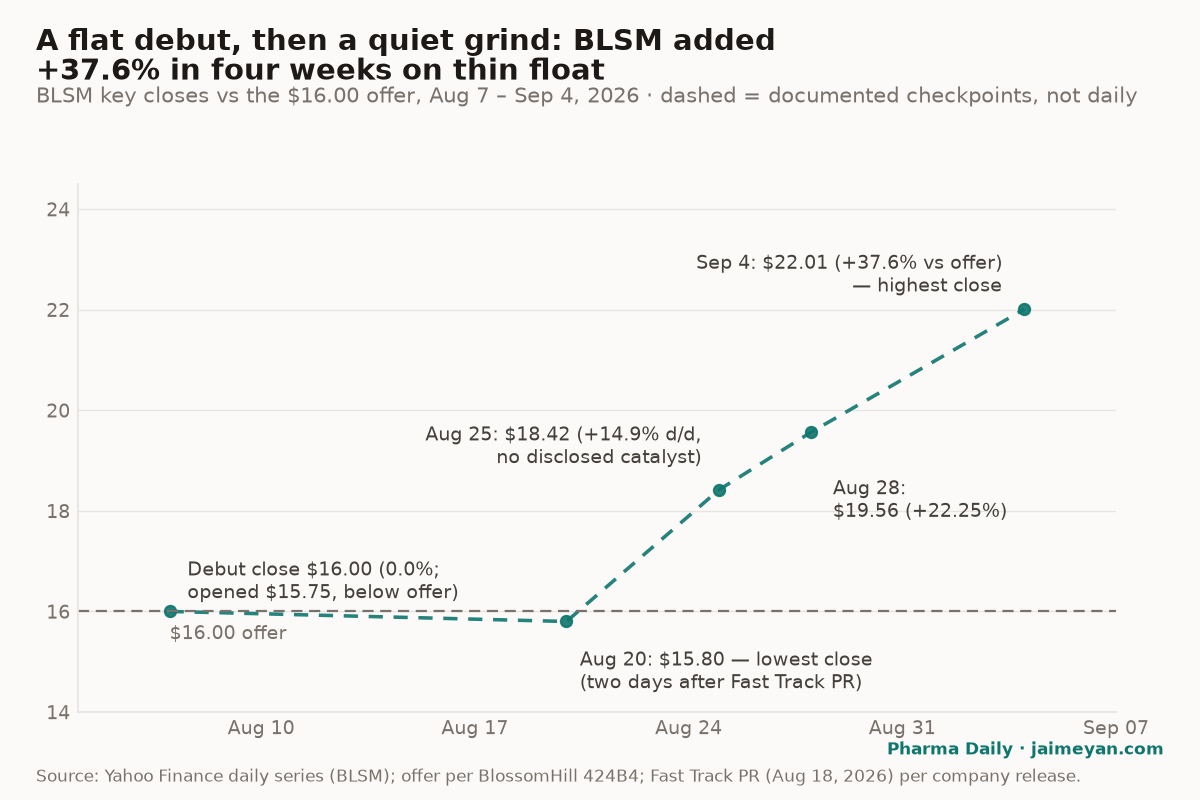
Figure 1: BLSM’s re-rate came after the Fast Track news, not on it — the biggest single-day move (August 25) has no documented catalyst, which is what thin-float price action looks like. Documented closes per the Yahoo Finance daily series; dashed segments connect documented checkpoints, not a daily series.
Read against the class bifurcation — late-stage single-asset stories rewarded, platform narratives punished, as with Eikon and Generate on the punished side — BlossomHill refines the rule rather than breaking it. What it sold at pricing was not a discovery engine but one lead asset with a 20%-plus response rate in humans, a named resistance mutation, a founder who has invented three approved kinase inhibitors, and a meeting date with the FDA. That is closer to Aktis’s single-asset clarity than to the platform pitch, even though the stage is earlier. The caution is mechanical: with the greenshoe unexercised and only 9.375M shares in the float, the +37.6% mark prices scarcity as much as data.
What would change the story
- End-of-Phase 1 FDA meeting, Q4 2026 — whether the accelerated-approval path in C797S NSCLC holds is the nearest binary.
- First patient in the registrational Phase 2, guided Q1 2027, and durability data in H1 2027 — the >20% response rate has to survive longer follow-up (NCT06706076).
- BH-30236 updated Phase 1 data, H1 2027 — the AML/MDS leg of the valuation (NCT06501196).
- The first 10-Q — none exists through September 5; it will replace the ~$134.9M net-proceeds estimate with an actual and give the first post-IPO cash balance.
One Take
BlossomHill is the refinement I would add to the bifurcation finding: the tape does not require late stage, it requires a date — a Phase 1/2 asset with human responses, a named resistance niche, and an FDA meeting on the calendar cleared the bar that platform stories at Eikon and Generate did not. The Cui pedigree is doing real work here; the market is paying for the inventor of XALKORI and LORBRENA to take one more EGFR shot, and the insider IPO buys ($15.0M disclosed via 13Ds, plus a derived ~$3.0M Vivo add) say the crossover register agreed. My conviction is low-to-moderate that BLSM holds its premium into the Q4 2026 FDA meeting, because the float is tiny, the biggest up-day had no news, and the unexercised greenshoe tells you even the book-runners did not chase. Falsifiers: the Q4 meeting failing to produce an accelerated-approval path, the registrational Phase 2 slipping past Q1 2027, or durability data in H1 2027 eroding the response rate — any of the three reprices this from “dated story” to “early platform,” which is exactly the profile the class has punished.
Key takeaways
- BlossomHill priced 9,375,000 shares at the $16.00 midpoint on August 6, 2026 for $150.0M gross — upsized 20% from the marketed 7,812,500 — at 0.5x the $295M class median.
- Insiders put $15.0M of disclosed IPO purchases in the deal (OrbiMed $10.0M, Cormorant $5.0M per 13Ds; Vivo’s 13G implies a further ~$3.0M add), and Perceptive Advisors appeared as a new 5.9% holder.
- The 15% greenshoe was apparently never exercised — the closing 8-K and the 13D/13G share math both match the base deal — so net proceeds remain the ~$134.9M prospectus estimate until a 10-Q exists.
- The stock went 0.0% on debut, bottomed at a $15.80 close on August 20, and reached its highest close of $22.01 (+37.6%) on September 4 — with the largest single-day move (+14.9%, August 25) tied to no disclosed catalyst.
- Against the class’s bifurcation, BlossomHill shows the tape will pay for early stage when the story carries human response data and a dated FDA path — the reward attaches to the schedule, not the stage.
FAQ
Who founded BlossomHill Therapeutics?
J. Jean Cui (CEO) and Y. Peter Li (Executive Chairman), the husband-and-wife team behind Turning Point Therapeutics, which BMS acquired in 2022; Cui was lead inventor of XALKORI, LORBRENA, and AUGTYRO. Note a correction to the parent brief: no “Bradley” appears anywhere in the prospectus.
Was BlossomHill’s greenshoe exercised?
Apparently not. The August 10 closing 8-K reports only the base 9,375,000 shares, the mid-August 13D/13G ownership percentages match the pre-exercise share count (30,643,660), and no exercise release or filing exists through September 5.
What is the next BLSM catalyst?
The end-of-Phase 1 FDA meeting on an accelerated-approval path for BH-30643 in C797S-positive NSCLC, guided for Q4 2026, followed by first patient in the registrational Phase 2 in Q1 2027.
Sources
First-hand (filings, releases, registry):
- BlossomHill 424B4 final prospectus (pipeline, data cuts, use of proceeds, principal stockholders, capitalization) — SEC EDGAR, 2026-08-07
- BlossomHill S-1, July 17, 2026 and S-1/A, August 3, 2026 (7,812,500 shares at $15.00–17.00) — SEC EDGAR
- BlossomHill Announces Pricing of Upsized $150 Million IPO — company IR/GlobeNewswire, 2026-08-06
- 8-K, August 10, 2026 (IPO closing: 9,375,000 shares at $16.00) — SEC EDGAR
- FDA Fast Track designation for BH-30643 — GlobeNewswire, 2026-08-18
- OrbiMed 13D (625,000-share IPO purchase; 8.9%) · Cormorant 13D (312,500-share IPO purchase; ~11.8%) · Vivo 13G (1,681,240 shares post-IPO; 5.5%) · Perceptive 13G (new 5.9% holder) — SEC EDGAR
- EDGAR submissions JSON for CIK 0001839970 (filing history; no 10-Q through Sep 5) — SEC
- ClinicalTrials.gov: NCT06706076 (SOLARA, BH-30643) · NCT06501196 (BH-30236)
Aftermarket and context:
- The New Biotech IPO Class: Bigger, Later-Stage, and Judged Harder — Pharma Daily (parent analysis; class table and $295M median)
- BlossomHill, Latigo outshine IPO expectations with oversubscribed debuts — Fierce Biotech, 2026-08-07
- BlossomHill eyes IPO to grow taller in crowded cancer fields — Fierce Biotech, 2026-07-17
- BlossomHill Therapeutics — Ones to Watch — The Pharma Letter
Provenance: collected 2026-09-05. Filing figures from the EDGAR documents above; prices (debut close $16.00; Aug 20 $15.80; Aug 24 $16.03 → Aug 25 $18.42; Aug 28 $19.56; Sep 4 $22.01) via the Yahoo Finance daily series for BLSM. Percentages versus the $16.00 offer are computed from those closes; “highest/lowest close” refer to closing prices, not intraday extremes. ClinicalTrials.gov enrollment figures (675 and 170) are registry estimates; patient counts quoted in the text are company-reported actuals from the 424B4. Net proceeds are the prospectus estimate; no 10-Q existed at collection time. All performance figures are marked to the September 4, 2026 close and will move with the market.