SpyGlass Pharma priced its IPO at the midpoint of its range on February 5, 2026 — 9,375,000 shares at $16.00 for $150 million gross, $172.5M after the greenshoe was exercised in full — and closed its first session up 65.0% at $26.40. As of the September 4 close the stock trades at $28.94, +80.9% versus offer.
TL;DR — SpyGlass (Nasdaq: SGP) is a small-deal proof that structure beats size: no upsize, no disclosed anchors, a $150M base deal — 0.51x the class median — built on a single late-stage asset with a de-risked API (bimatoprost, approved topically since 2001) on the 505(b)(2) pathway. The one post-IPO data event (12-month Phase 1/2 durability, March 9) confirmed the thesis; a June slide to $17.56 — within 10% of the offer — was the tape’s only real test, and it recovered on no news. Cash and short-term investments of $234.2M at June 30 fund operations through 2028. Performance figures are marked to the September 4 close; prices move daily. Caveat: the two Phase 3s complete enrollment in 2027 and the NDA is planned for 2028 — the runway (“through 2028”) and the filing land in the same year, so a raise before approval is likely.
This is a per-company companion to our 2026 IPO class deep-dive. SpyGlass, Avalyn, and Veradermics form the class’s quiet middle: no platforms, no China in-licenses, no record checks — just dated, visible paths.
The asset: a bimatoprost-eluting IOL, implanted during routine cataract surgery
The Bimatoprost Drug Pad-IOL System is exactly what it sounds like: proprietary drug pads mounted on an intraocular lens, implanted during standard cataract surgery, designed to deliver three years of the prostaglandin analog bimatoprost to lower intraocular pressure in open-angle glaucoma and ocular hypertension. It is a drug-led drug-device combination on the 505(b)(2) pathway — the API has been approved since 2001; the bet is entirely on delivery.
The clinical record at IPO: a first-in-human feasibility study showing a 37% mean IOP reduction at 36 months with 95% of evaluable patients off all drops, and the Tigris Phase 1/2 RCT (NCT06120842) showing 37%/36% mean IOP reductions at 3 months with 97% off drops. The one post-IPO data print (March 9): 12-month Tigris results — 34% (78-mcg) and 42% (39-mcg) mean IOP reduction versus 35% on the timolol control, 97% off drops, and 100% of patients reaching BCDVA 20/32 or better.
Two registrational Phase 3s — Rhine (NCT07218783) and Rhone (NCT07218796), 400 patients each versus timolol — were initiated in July 2025 per the S-1/A (the registry lists October 2025 start dates, and first patients were randomized in January 2026), with enrollment completion expected in 2027, primary completions in March and May 2029, and the NDA planned for 2028. A second program, BIM-DRS (a ring-shaped implant for pseudophakic patients), has its first-in-human trial planned for H2 2026 (NCT07641296, not yet recruiting).
Origin: founded in 2019 by Malik Kahook and Glenn Sussman out of the University of Colorado’s eye center, with an exclusive worldwide license to the underlying patents — priced at a one-time $60,000 fee (plus university shares, a small annual fee, and up to $1.05M of milestones per product). Private capital in: roughly $167M across the C-1, C-2, and D rounds (2023–2025), from NEA (28.6% pre-IPO), RA Capital (19.2%), Vensana (14.0%), Gilde, Sands, and Samsara.
The deal: the plainest structure in the class
| Step | Shares | Price | Gross |
|---|---|---|---|
| S-1 (Jan 16) | blanks | — | — |
| Marketed range (S-1/A, Jan 29) | 9,375,000 | $15–17 | $141–159M |
| Priced (Feb 5) — at midpoint | 9,375,000 | $16.00 | $150.0M |
| Greenshoe exercised in full (closed Feb 9) | 10,781,250 | $16.00 | $172.5M |
Table 1: SpyGlass pricing per the S-1, the S-1/A, the pricing release, and the Q2 10-Q (full greenshoe; $157.7M net cash proceeds).
No upsize, no price revision, no cornerstone — the plainest deal we have logged in this series. The syndicate (Jefferies, Leerink, Citigroup, Stifel) still took the full greenshoe, which at $16 and a +65% first-day close was free money. The closing 8-K also carried a director appointment: Habib Dable, the former Acceleron CEO.
The tape: held the pop, survived one scare
SGP never dipped below water after its debut, but it tested holders in June: from the $29.68 closing high (February 19) the stock slid to $17.56 on June 16 — within 10% of the offer — on no company-specific disclosure. The grind back was equally quiet: $26.42 by August 28, $28.94 on September 4. The March 9 data print was the only dated clinical event; the rest of the tape is float mechanics on 33.4M shares outstanding (June 30).
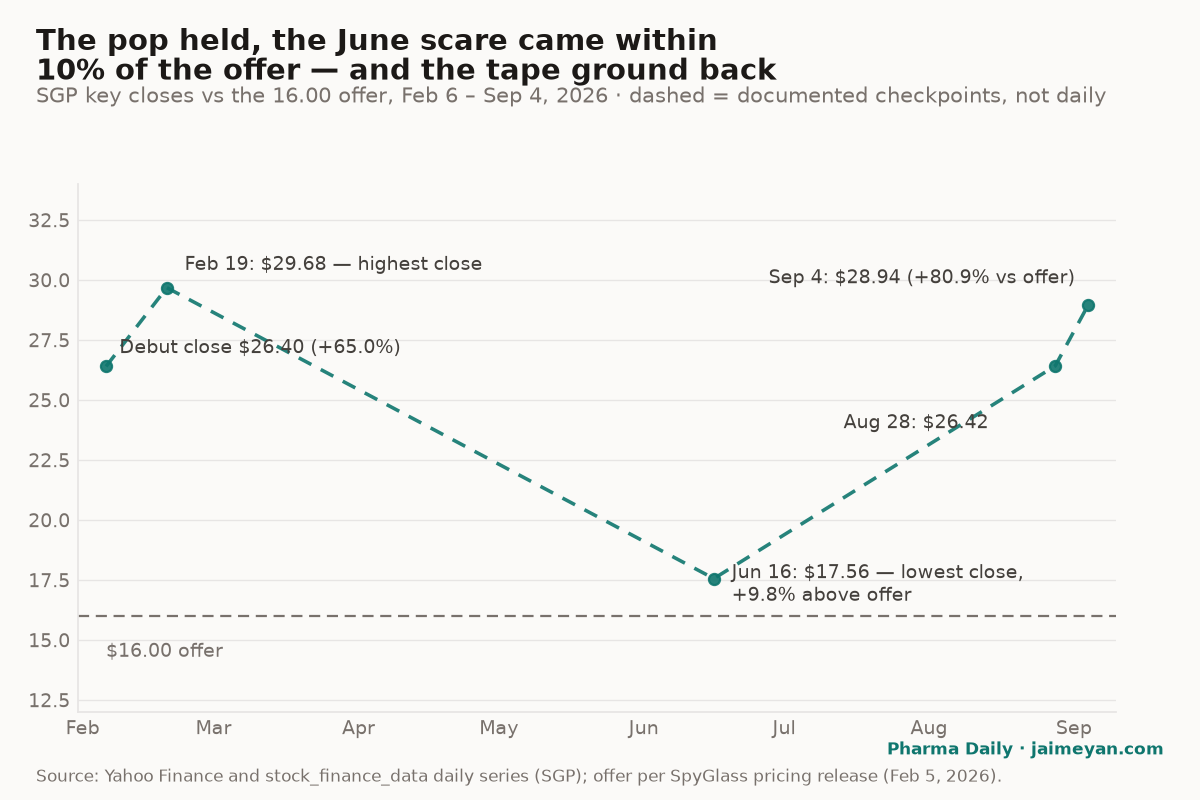
Figure 1: SGP’s tape in three acts — +65% pop, a four-month fade to within 10% of issue, and a quiet recovery to +80.9%. Documented closes per the Yahoo Finance and stock_finance_data series; dashed segments connect documented checkpoints, not a daily series.
Against the class bifurcation: SpyGlass confirms the pattern from the other end of the size distribution. The rewarded profile — single asset, human data, de-risked API, dated pivotal path — does not require a $300M check. It requires a story the tape can verify.
What would change the story
- Phase 3 enrollment completion, guided 2027 — the pacing item for the 2028 NDA.
- BIM-DRS first-in-human, H2 2026 (NCT07641296) — extends the franchise beyond cataract-surgery patients.
- The financing question — runway “through 2028” against a 2028 NDA plan: a raise before approval is the base case, and its terms will say how the register marks the Phase 3s.
- Rhine/Rhone primary completions, March/May 2029 — the actual verdicts.
One Take
SpyGlass is the class’s control for check size: everything the winners share — single asset, human data, de-risked chemistry, dated path — at half the median raise and none of the ceremony. I read the June slide to $17.56 as the price of that plainness: no anchor, no strategic partner, and only 33.4M shares outstanding means the bid vanishes when the IPO sponsors rotate out, and the recovery back above $26 says fundamentals buyers replaced them without a single new data point. The real tension is ahead: two 400-patient Phase 3s against a runway that ends the year the NDA is due. Conviction: moderate that SGP’s next re-rating is the 2027 enrollment completion, and that the intervening tape stays float-driven and jumpy. Falsifiers: enrollment slipping past 2027, a BIM-DRS FIH delay past this half, or a discounted raise before any pivotal data — the last would reprice the whole “de-risked path” premium the stock currently enjoys.
Key takeaways
- SpyGlass priced $150M at the $16 midpoint on February 5 — no upsize, no anchors — and closed at $172.5M with the full greenshoe, the smallest deal among our per-company deep-dives at 0.51x the class median.
- The asset is a bimatoprost-eluting IOL on 505(b)(2): an API approved since 2001 with a delivery bet; 12-month Phase 1/2 showed 34–42% IOP reductions with 97% of patients off drops.
- The tape: +65.0% debut, a June 16 low close of $17.56 (within 10% of offer), and +80.9% as of September 4 — float-driven swings on a 33.4M-share count.
- Two Phase 3s (Rhine, Rhone) complete enrollment in 2027 with primary completions in early 2029; the NDA is planned for 2028, the same year the cash runway ends.
- The Colorado license behind the company cost a one-time $60,000 fee — the cheapest origin story in the class.
FAQ
What exactly is SpyGlass’s product?
Drug pads mounted on an intraocular lens, implanted during routine cataract surgery, releasing bimatoprost for three years. It is a drug-device combination on the 505(b)(2) pathway — the API is approved since 2001; the innovation is sustained delivery, and the pivotal trials (Rhine/Rhone) read out in 2029.
Why did the stock nearly round-trip in June?
No company disclosure explains it — the 8-K log is clean. The structural read: only 33.4M shares outstanding and no anchor book mean thin sponsorship after the IPO holders rotate. The recovery to +80.9% occurred without new clinical data beyond the March 9 print.
What is the next SGP catalyst?
BIM-DRS first-in-human in H2 2026, then Phase 3 enrollment completion in 2027. The binary verdicts are the Rhine/Rhone primary completions in March and May 2029.
Sources
First-hand (filings, releases, registry):
- SpyGlass Announces Pricing of IPO (9,375,000 shares at $16.00) — GlobeNewswire, 2026-02-05
- SpyGlass S-1, January 16, 2026 and S-1/A, January 29, 2026 (range $15–17) — SEC EDGAR
- SpyGlass 424B4 final prospectus (full submission text) — SEC EDGAR
- SpyGlass Q2 2026 10-Q (full greenshoe; $157.7M net cash proceeds; cash + ST investments $234.2M; full submission text) — SEC EDGAR
- 8-K, March 9, 2026 (12-month Phase 1/2 topline) — SEC EDGAR
- Q2 2026 results release (runway through 2028; Phase 3 enrollment on track) — SEC EDGAR
- Closing 8-K, February 9, 2026 (Habib Dable appointed director) — SEC EDGAR
- ClinicalTrials.gov: NCT07218783 (Rhine) · NCT07218796 (Rhone) · NCT06120842 (Tigris) · NCT07641296 (BIM-DRS FIH)
Aftermarket and context:
- The New Biotech IPO Class: Bigger, Later-Stage, and Judged Harder — Pharma Daily (parent analysis; class table and median)
- Agomab, SpyGlass bank a combined $350M in biotech IPOs — BioPharma Dive, 2026-02-05
- Immunology biotech Agomab, eye-focused SpyGlass share IPO ambitions — Fierce Biotech, 2026-01-19
Provenance: collected 2026-09-05. Filing figures from the EDGAR documents above; prices (debut close $26.40; Feb 19 $29.68; Jun 16 $17.56; Aug 28 $26.42; Sep 4 $28.94) via the Yahoo Finance daily series and the stock_finance_data feed for SGP. Percentages vs the $16.00 offer are computed from those closes; “highest/lowest close” refer to closing prices, not intraday extremes. No anchor-investor disclosure exists in the 424B4; we say so rather than infer. All performance figures are marked to the September 4, 2026 close and will move with the market.