Scribe Therapeutics priced an upsized IPO at the top of its range on July 23, 2026 — 8,580,000 shares at $15.00 for $128.7M gross — and closed four days later at $148.0M after the underwriters exercised the full greenshoe, plus a concurrent $7.5M private placement to Sanofi. As of the September 4, 2026 close the stock trades at $28.67, +91.1% versus offer.
TL;DR — Scribe (Nasdaq: SCTX; the class table left the ticker unverified, confirmed here from the 8-A) is the 2026 class’s platform counterexample: a CRISPR-CasX company whose lead program was still in first-in-human Phase 1 at pricing, yet nearly doubled in six weeks. The deal economics explain part of it — insiders bought $50M of the offering at pricing (Avoro $35M, OrbiMed $15M, per their 13Ds), Sanofi added $7.5M alongside, and over $180M of collaboration cash from Sanofi and Lilly had already validated the platform. Three corrections to the parent table: pricing was announced July 23 (July 24 was the first trading day); the $129M headline is stale — final gross is $148.0M with the shoe, $155.5M with the placement; and the lead asset is epigenetic silencing, not gene editing. Performance figures are marked to the September 4 close; prices move daily. Caveat: the entire aftermarket rests on preclinical and platform evidence — the first human data are guided for H1 2027.
This is a per-company companion to our 2026 IPO class deep-dive, which found the aftermarket rewarding late-stage single-asset stories and punishing platform narratives. Scribe is the name that finding has to answer for.
The asset: epigenetic silencing first, gene editing second — and only Phase 1
The lead program, STX-1150, uses Scribe’s ELXR (Epigenetic Long-Term X-Repressor) technology to silence PCSK9 in the liver and durably lower LDL-C — an LNP-delivered mRNA plus guide RNA given by IV infusion, built on the company’s CasX enzyme. It is not a gene editor: ELXR represses expression without altering DNA. That is a refinement of the parent table, which grouped Scribe under in vivo editing; the X-Editor (XE) editing programs — STX-1200 (LPA, for elevated lipoprotein(a)) and STX-1400 (APOC3, for severely high triglycerides) — are both preclinical.
STX-1150 entered the clinic just before the IPO: Australian TGA clearance, then a first-in-human Phase 1 in Australia in adults with elevated LDL-C and increased ASCVD risk — NCT07428473, led by Monash University (investigator Stephen Nicholls) with Scribe as industry collaborator. The 424B4 describes up to 64 participants; the registry lists an estimated enrollment of 64 (recruiting, estimated start June 2026, estimated primary completion December 30, 2028) — no actual enrollment has been reported, so treat the 64 as the registry estimate it is. Initial safety, tolerability, and LDL-C data are guided for H1 2027.
The preclinical package behind it (presented as an EAS late-breaker per the September 2 release): a single dose in non-human primates produced up to 90% PCSK9 silencing and up to 68% LDL-C reduction, with a 0.75 mg/kg dose holding LDL-C reduction above 50% for two years and liver enzymes comparable to saline. For STX-1200/STX-1400: over 90% target-expression reduction in mouse models, over 95% Lp(a) reduction and over 75% APOC3 on-target editing in NHP surrogates, and no detectable off-target editing in primary human hepatocytes at supersaturating doses; more than $25M in CIRM grant funding supports both. All three internal programs are wholly owned.
The platform validation is financial as much as scientific. The 2023 Sanofi license (CasX editing for in vivo sickle cell disease) paid $40M upfront with up to $410M in development/regulatory and $825M in commercial milestones; the 2023 Lilly deal (via Prevail, neurological and neuromuscular targets) paid $45M upfront with up to $110M R&D and $1.1B commercial milestones. Total collaboration cash received to date: over $180M. Co-founded in 2017 by CEO Benjamin Oakes, Brett Staahl, David Savage, and Nobel laureate Jennifer Doudna (7.08% pre-IPO), Scribe raised roughly $150M of private equity with, per the 424B4, only one dilutive financing in the past four years.
The deal: upsized 20%, top of range, full shoe — and insiders anchored it
| Step | Shares | Price | Gross |
|---|---|---|---|
| Marketed range (S-1/A, Jul 20) | 7,150,000 | $13–15 | ~$93–107M |
| Priced Jul 23 (FWP) — top of range, upsized | 8,580,000 | $15.00 | $128.7M |
| Greenshoe exercised in full (closed Jul 27, per 10-Q) | 9,867,000 | $15.00 | $148.0M |
| Concurrent Sanofi private placement (Aventis + Genzyme) | 500,000 | $15.00 | $7.5M |
| Total IPO + placement | 10,367,000 | $15.00 | ~$155.5M |
Table 1: Scribe pricing steps per the S-1/A, the pricing release (FWP), the 424B4, and the Q2 2026 10-Q, which confirms the full greenshoe exercise and the July 27 closing. Net proceeds were approximately $140.7M per the 10-Q (the Q2 release says $140.6M); the 424B4’s $122.8M was the pre-greenshoe estimate.
Two corrections to the record. First, the parent table dated pricing to July 24; the pricing release is dated July 23 (after the close), and July 24 was the first trading day. Second, the widely carried “$129M IPO” (Fierce Biotech’s headline) is the pricing-day number — it omits the full 1,287,000-share greenshoe confirmed in the 10-Q and the Sanofi placement.
Unlike Avalyn, where no cornerstone was disclosed, this book was visibly anchored. Avoro (via director Behzad Aghazadeh) bought 2,333,333 IPO shares at $15.00 — about $35M — per its Schedule 13D; OrbiMed bought 1,000,000 shares ($15M) per its 13D. These are disclosed purchases, not non-binding indications. RA Capital reported 1,802,178 shares (9.6%) as of July 27 — a new position around the IPO, since it was not a pre-IPO 5% holder — and Eli Lilly filed a 13D at 7.3%. Andreessen Horowitz remains the largest holder at 15.61% post-IPO (from 32.24%). The syndicate — Leerink, Goldman Sachs, Guggenheim, Wells Fargo — took the full 15% shoe. At $148.0M, the IPO is 0.5x the $295M class median; $155.5M with the placement is 0.53x.
The tape: +91% on no new clinical data
No public price feed carries a July 24 daily bar; the first quoted bar is July 27 (open $21.48, close $18.97, −12.38% day-over-day). That decline implies a debut close near $21.65, +44.3% versus the $15.00 offer — derived, not directly quoted, so treat it as corroborated rather than sourced. The Yahoo feed’s own chartPreviousClose ($21.48, implying +43.2%) lands slightly lower than the stockanalysis-derived figure; both are derived, and we quote the range +43–44%. The lowest close came the next day: $18.06 on July 28 (+20.4%; intraday low $17.305 on July 27).
The re-rate came in August. On August 18 the stock jumped 27.9% to $27.11 on 507k shares with no 8-K or press release that day; the timing matches the expiry of the 25-day underwriter quiet period and the analyst-initiation wave — an inference from the filing calendar, not a sourced fact. The highest close was $37.25 on August 24 (+148.3%; intraday high $39.60 on August 20), followed by a 16.2% giveback to $31.21 on August 25. The September 2 Q2 print — event and filing the same day — added 6.6% to $30.90 on cash-plus-proceeds runway into H1 2029, the CIRM awards, and confirmation of the full shoe. September 4 close: $28.67, +91.1% versus offer.
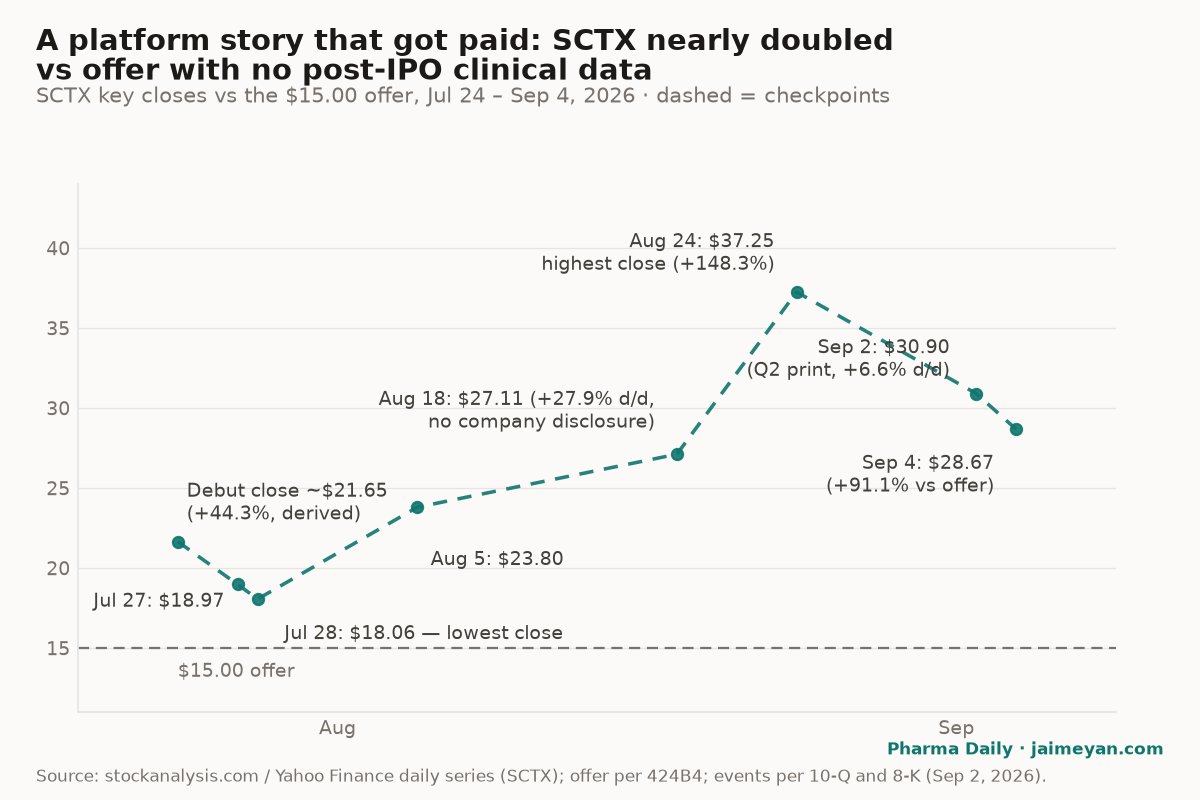
Figure 1: SCTX key closes versus the $15.00 offer, July 24 – September 4, 2026. The debut close is derived from the July 27 change; “highest/lowest” refer to closing prices, not intraday extremes. Dashed segments connect documented checkpoints, not a daily series. Sources: stockanalysis.com / Yahoo Finance daily series; offer per the 424B4.
Against the class bifurcation: Scribe contradicts the finding as stated — a Phase 1-stage platform that the tape paid for, while Eikon and Generate priced below offer on platform stories. The refinement is in the collateral: Scribe arrived with $180M-plus of pharma collaboration cash, a full greenshoe, and $62.5M of disclosed insider and partner buying in the deal itself (Avoro $35M, OrbiMed $15M, Sanofi $7.5M placement, Lilly $5M per its 13D). The market did not pay for a platform narrative; it paid for a platform that had already been paid for by Sanofi and Lilly.
What would change the story
- STX-1150 initial Phase 1 data, H1 2027 — safety, tolerability, and LDL-C reduction in humans for the first time; the binary the whole equity story now points at (NCT07428473; registry-estimated primary completion December 2028).
- Lockup expiry, January 2027 — 180 days from pricing for officers, directors, and substantially all existing holders; with insiders this concentrated, the post-expiry 13D/G flow matters.
- STX-1200/STX-1400 progression — both are preclinical with CIRM support; an IND-track milestone would extend the story beyond a single Phase 1 asset.
- Milestone flow from Sanofi/Lilly — collaboration revenue already fell to $1.9M in Q2 2026 from $4.9M a year earlier; fresh milestone triggers would re-validate the partnered programs.
- A raise before the data — runway is guided into H1 2029 on Q2 cash of $43.0M plus ~$140.7M net proceeds per the 10-Q; financing ahead of H1 2027 data would contradict that guidance.
One Take
Scribe is the name that forces the class’s bifurcation finding to be refined rather than confirmed. The tape did not punish this platform story — it paid +91.1% for one as of September 4 — but the payment tracks collateral, not narrative: over $180M of collaboration cash already banked from Sanofi and Lilly, a Nobel-laureate-founded enzyme, and $50M of the deal bought at pricing by insiders whose 13Ds prove it. That is a different asset from the narrative-only platforms that priced below offer, and I would file Scribe as “validated platform,” a category the parent table’s bifurcation line does not capture. My caution: none of the post-IPO re-rating rests on a patient — the two biggest up-days came on analyst initiations and a financial-results 8-K — so the stock is currently a claim on register quality and platform credibility, marked at nearly twice the price sophisticated holders paid in July. Conviction: moderate that SCTX trades on coverage and positioning until the H1 2027 STX-1150 readout, because nothing clinical is scheduled before then. Falsifiers: a safety signal or weak LDL-C knockdown in that readout, any financing before the data despite the stated H1 2029 runway, or heavy insider distribution after the January 2027 lockup expiry — the last would say the anchors bought the deal for the syndicate, not for the asset.
Key takeaways
- Scribe priced 8.58M shares at the $15.00 top of range on July 23 (first trade July 24), closed July 27 at $148.0M after the full greenshoe, and added Sanofi’s $7.5M concurrent placement: ~$155.5M gross, ~$140.7M net per the 10-Q, 0.5x the $295M class median.
- The book was anchored, not indicated: Avoro bought ~$35M and OrbiMed $15M of the IPO at pricing per their 13Ds; RA Capital crossed 9.6% at pricing; a16z remains the largest holder at 15.6%.
- The tape ran +91.1% versus offer as of the September 4 close — implied debut +43–44% (derived; feeds disagree: $21.65 via stockanalysis, $21.48 via Yahoo), lowest close $18.06 (July 28), highest close $37.25 (August 24) — on zero post-IPO clinical data.
- Lead asset STX-1150 is ELXR epigenetic silencing of PCSK9 (Phase 1 in Australia; initial data H1 2027), not gene editing; the XE editors STX-1200/STX-1400 are preclinical.
- The “$129M IPO” headline is the pricing-day number; the final figure with the full shoe and the Sanofi placement is $155.5M.
FAQ
Is Scribe’s lead drug a gene editor?
No. STX-1150 uses Scribe’s ELXR technology to epigenetically silence PCSK9 without altering DNA; the actual gene-editing programs (STX-1200, STX-1400, on the X-Editor) are still preclinical. The parent class table grouped Scribe under in vivo editing — that framing needs the correction.
Why is a Phase 1 platform up 91% while other 2026 platform IPOs broke?
Because the platform arrived pre-validated: over $180M of collaboration cash from Sanofi and Lilly, a $7.5M Sanofi placement at pricing, $50M of insider buying confirmed by 13D filings, and a greenshoe exercised in full. The two biggest single-day moves came on analyst initiations and the Q2 print, not on clinical data — so the premium currently rests on register and coverage, not patients.
What is the next SCTX catalyst?
Initial STX-1150 Phase 1 safety and LDL-C data, guided for H1 2027. Before that, the 180-day lockup expires in January 2027 — worth watching given how concentrated the insider register is.
Sources
First-hand (filings, releases, registry):
- Pricing release, carried as FWP (8,580,000 shares at $15.00, upsized) — SEC EDGAR, 2026-07-23
- S-1/A, July 20, 2026 (marketed terms: 7,150,000 shares at $13–15) — SEC EDGAR
- 424B4 final prospectus (pipeline, ELXR/XE, Sanofi and Lilly deals, principal stockholders, lockup, directed share program) — SEC EDGAR
- 8-A registration (SCTX, Nasdaq Global Market) — SEC EDGAR
- Q2 2026 10-Q (full greenshoe exercise; Sanofi private placement; cash $43.0M; net proceeds ~$140.7M) — SEC EDGAR
- 8-K, July 27, 2026 (charter/bylaws effective at closing) — SEC EDGAR
- 8-K and Q2 2026 results exhibit, September 2, 2026 (runway into H1 2029; CIRM awards; NHP data) / Ex-99.1 — SEC EDGAR
- Schedule 13D/G filings: Avoro · OrbiMed · RA Capital · Eli Lilly — SEC EDGAR
- ClinicalTrials.gov: NCT07428473 (STX-1150 Phase 1; the only Scribe-affiliated trial on the registry)
Aftermarket and context:
- The New Biotech IPO Class: Bigger, Later-Stage, and Judged Harder — Pharma Daily (parent analysis; class table and median)
- Scribe records upsized $129M IPO — Fierce Biotech, 2026-07-24
- Cardiovascular disease biotech Scribe Therapeutics sets terms for $100 million IPO — Renaissance Capital, 2026-07-20
Provenance: collected 2026-09-05. Filing figures from the EDGAR documents above; prices via the stockanalysis.com SCTX daily series and the Yahoo Finance daily series. Neither feed carries a July 24 bar; the implied debut close of ~$21.65 (+44.3%) is derived from the July 27 close and its −12.38% day-over-day change, not directly quoted. The two feeds disagree on the prior close — Yahoo’s chartPreviousClose of $21.48 implies +43.2% — so the derived debut premium is quoted as +43–44%. Percentages versus the $15.00 offer are computed from closing prices; “highest/lowest” refer to closes, not intraday extremes. ClinicalTrials.gov enrollment and completion dates for NCT07428473 are registry estimates; the company has reported no actual enrollment. All performance figures are marked to the September 4, 2026 close and will move with the market.