Parabilis Medicines priced the largest biotech IPO to date on June 9, 2026: 33.5 million shares at $20.00, above the $17–19 marketed range, for $670 million gross — upsized twice in the five days between its first price-range amendment and pricing. As of the September 4 close the stock traded at $40.42, +102.1% versus offer.
TL;DR — Parabilis (Nasdaq: PBLS) raised $670M at pricing ($770.5M after the greenshoe was exercised in full), 2.3x the 2026 class median of $295M, and Regeneron added a separate $75M concurrent placement at a 10% discount on top of a $50M-upfront research collaboration signed 25 days before pricing. The stock closed its first day +58.0% and sits +102.1% vs offer as of September 4 — performance figures marked to that close; prices move daily. Caveat: the lead asset’s headline 74% response rate rests on 14 of 19 evaluable desmoid-tumor patients in an open-label Phase 1/2 — a thin base, and the planned registrational Phase 3 is not yet posted on ClinicalTrials.gov as of September 5.
This is the second per-company companion to our 2026 IPO class deep-dive, which found the aftermarket rewarding late-stage single-asset stories and punishing platform narratives. Parabilis is the stress test for that finding: it sold a platform story at a record size, and the tape has treated it like a product story.
The asset: zolucatetide, a β-catenin:TCF inhibitor with one registrational path
Zolucatetide is a Helicon — Parabilis’s name for stabilized helical peptides engineered to penetrate cells and bind flat intracellular protein surfaces. It inhibits the interaction between β-catenin and the TCF transcription-factor family, the downstream node of Wnt/β-catenin signaling; the company states it is, to its knowledge, the first drug to directly target that interaction. Activating β-catenin or APC mutations are present in over 10% of all cancers.
The data that priced this deal, from the June prospectus: as of February 16, 2026, 38 desmoid-tumor patients had been dosed with zolucatetide, 25 were response-evaluable, and all 25 showed tumor reductions (disease control rate 100%). Of the 19 patients with at least two post-baseline scans, 74% (14/19) had an objective response per RECIST 1.1 — including patients who failed gamma-secretase inhibitors and patients naive to them. Desmoid tumors are rare, locally invasive soft-tissue tumors; the company estimates roughly 11,000 U.S. patients are actively managed, and the only FDA-approved systemic therapy, a gamma-secretase inhibitor, does not address the underlying Wnt/β-catenin biology. Parabilis plans to initiate a global registrational Phase 3 in desmoid tumors in the first half of 2027.
Around that lead indication sits a deliberate expansion map, all in the ongoing Phase 1/2 (NCT05919264, 619 planned enrollment, recruiting, primary completion estimated April 2027):
- FAP (familial adenomatous polyposis, ~34,000 U.S. patients, no approved therapy): six FAP-desmoid patients enrolled; a dedicated FAP cohort starts in the second half of 2026.
- HCC: one heavily pre-treated CTNNB1-mutant patient held a confirmed partial response for nine months; an HCC-specific cohort is enrolling.
- Rare Wnt-driven tumors (adamantinomatous craniopharyngioma, solid pseudopapillary neoplasm, salivary gland tumors, ameloblastoma): partial responses observed; the company is weighing tumor-agnostic, genomically defined regulatory strategies.
- Colorectal cancer: disease stabilization and ctDNA reductions in a subset on monotherapy; combination regimens with anti-VEGF, DNA-damaging chemotherapy, and anti-PD-1 are in evaluation.
Behind zolucatetide, the pipeline is preclinical: two prostate-cancer degraders — an ERG degrader and an allosteric AR-ON degrader, the latter in late lead optimization — advancing toward IND-enabling studies. The Helicon platform itself — a decade of high-throughput peptide synthesis plus AI/physics-based models — is the pitch’s second act, and the source of the platform valuation debate.
Origin note: Parabilis was founded in 2015 as FOG Pharmaceuticals on technology in-licensed from Greg Verdine’s Harvard lab, renamed in October 2024, and states its current platform is not dependent on that original license. It raised over $800M privately (ARCH, Cormorant, Fidelity, GV, RA Capital, venBio, others) before the IPO. CEO Mathai Mammen previously ran global R&D at Johnson & Johnson.
The deal: upsized twice, priced above range, anchored at a discount
| Step | Shares | Price | Gross |
|---|---|---|---|
| Marketed range (S-1/A, Jun 4) | 25,000,000 | $17–19 | $425–475M |
| Upsized S-1/A (morning of Jun 9) | 33,333,334 | $17–19 | up to ~$633M |
| Priced (evening of Jun 9) | 33,500,000 | $20.00 | $670.0M |
| Greenshoe exercised in full (15%) | 38,525,000 | $20.00 | $770.5M |
| Regeneron concurrent placement (separate) | 4,166,666 | $18.00 (90% of offer) | $75.0M |
Table 1: Anatomy of the record. Share counts and prices per the Jun 4 S-1/A, the Jun 9 upsizing S-1/A, the pricing FWP, and the Q2 2026 10-Q (greenshoe exercise). “Up to ~$633M” marks the top of the marketed range, not a final term.
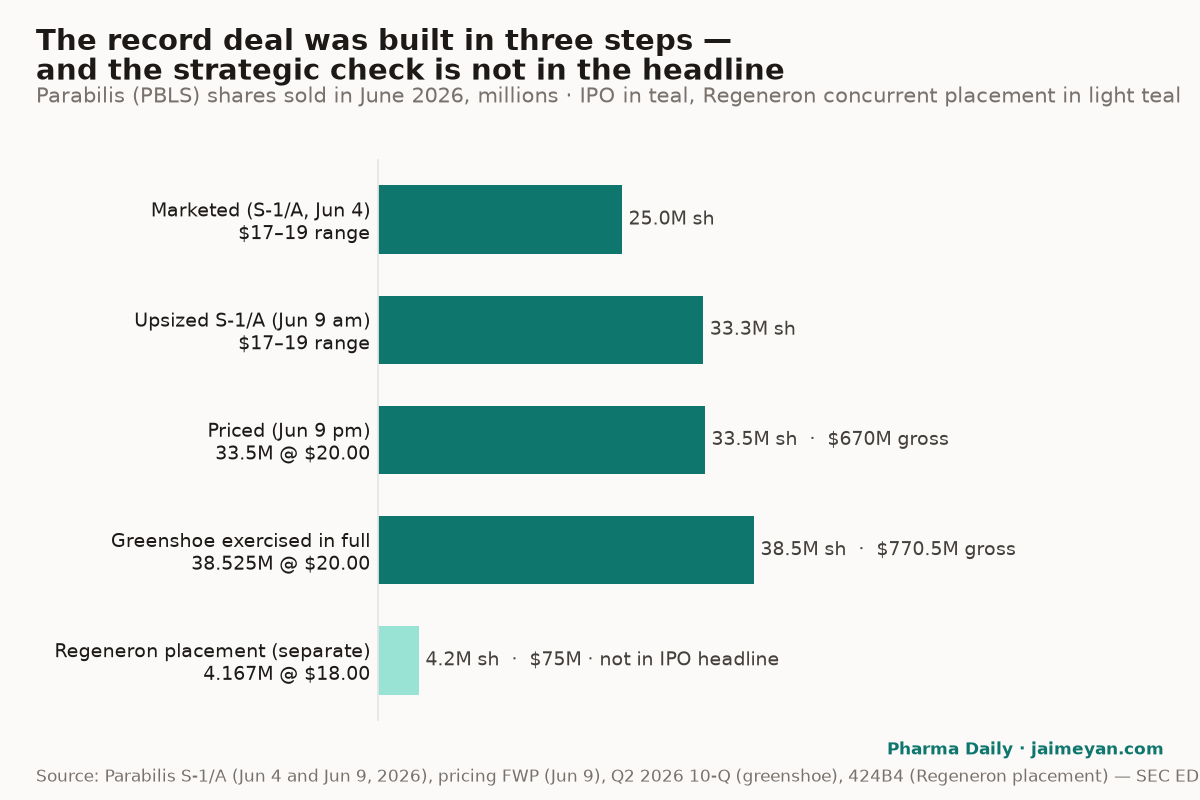
Figure 1: 41% of the shares Parabilis sold in June were added after the marketed range was set — and Regeneron’s $75M never entered the IPO headline. Method: share counts per the filings in Table 1.
Three structural points. First, demand was real: the base deal grew 34% (25.0M to 33.5M shares) and still priced a dollar above the range, and the underwriters — Leerink, BofA, Evercore ISI, Guggenheim, LifeSci — exercised the full 15% greenshoe. Second, the $670M headline understates the June haul: net IPO proceeds were $712.9M, and aggregate net including the Regeneron placement was $787.9M. Third, the Regeneron relationship is broader than the placement. The license and collaboration agreement, signed May 15, 2026 — twenty-five days before pricing — covers Antibody-Helicon Conjugates against a set of collaboration targets, with a $50M non-refundable upfront, up to roughly $2.2B in development, regulatory, and commercial milestones on the initial targets, and tiered high-single-digit to low-double-digit royalties. Regeneron may replace two targets and nominate up to five more.
Against the class table: $670M at pricing is 2.3x the 2026 median raise of $295M, and $770.5M as-exercised is 11.8% of the entire 21-deal class’s $6.52B. The record it broke was eight weeks old — Kailera’s $625M in April, which we cover in a companion piece.
The tape: a platform narrative priced like a single asset
PBLS opened at $33.35 on June 10 and closed its first session at $31.60, +58.0%. It has not come back: $39.11 on August 28 (+95.6%), $40.42 on September 4 (+102.1%, computed from the $20 offer), with a post-IPO trading range of $24.51–41.49. Daily volume has thinned to the tens of thousands of shares — 40,378 on September 4 — normal for a 12-week-old listing with most of the float locked up, but it means the mark is set by a small number of marginal trades.
Our class-level finding was bifurcation: late-stage single-asset stories rewarded, platform narratives punished (Eikon −39%, Agomab −18%, Generate −4% as of August 28). Parabilis is the class’s platform story by pitch — a novel modality, a discovery engine, a preclinical follow-on pipeline — and it is the fourth-best vs-offer performer in the class, behind only Veradermics, Vogenx, and Hemab. Our read of the tape: the market is not paying for the Helicon platform; it is paying for zolucatetide’s desmoid data with a registrational path attached, and treating the platform as an unpriced option. That confirms the bifurcation thesis rather than breaking it — the one platform that trades well is the one with a 74% response rate in hand.
One caveat cuts the other way: everything above the offer price rests on 19 evaluable patients in an open-label trial. The balance sheet, at least, is no longer a risk factor: $1.12B of cash, equivalents, and marketable securities at June 30 (including IPO and placement proceeds and the Regeneron upfront), a Q2 net loss of $52.5M on $39.4M of R&D, and runway guidance extended in the 10-Q from “the second half of 2029” at pricing to “into 2030.”
What would change the story
- The desmoid Phase 3. Guided for H1 2027 and not yet posted on ClinicalTrials.gov as of September 5. A posted protocol — or a slip — is the nearest hard marker.
- More zolucatetide data. The Phase 1/2’s estimated primary completion is April 2027; data cuts on broader enrollment will show whether 74% holds or reverts. The dedicated FAP cohort starts H2 2026.
- The CMO transition. An 8-K filed September 2 (event date August 28) disclosed that CMO Fawzi Benzaghou departs effective September 30 — in the run-up to the guided H1 2027 registrational start. The board added Craig Tendler effective August 22 (8-K filed August 25).
- Regeneron execution. Target nominations and any AHC milestone movement convert the platform option into revenue line items.
One Take
Parabilis looks like the exception to this class’s bifurcation rule — a platform story trading at double its offer — and I think that misreads what the tape is paying for. The +102% marks zolucatetide’s desmoid-tumor responses, not the Helicon engine: every data point behind the valuation is single-asset, and the one registrational trial on the calendar is a desmoid trial. The honest caveat is sample size — 14 responses among 19 evaluable patients in an open-label Phase 1/2 is a thin base under a $770M-as-exercised deal — and the Phase 3 that would resolve it is not yet on the registry. Regeneron’s $125M commitment (a $50M upfront plus $75M of equity at a 10% discount, signed 25 days before pricing) is the strongest third-party validation any 2026 IPO carried to market, but a discounted anchor is a hedge, not a hug. Conviction: moderate that PBLS holds above water into year-end. Two things would change my mind: the desmoid Phase 3 failing to start by mid-2027, or response rates drifting materially below 70% as enrollment broadens — and I would not dismiss the quiet items: the CMO exits September 30, sixteen weeks after pricing, on the doorstep of the trial that justifies the valuation.
Key takeaways
- Parabilis priced $670M at $20.00 on June 9 — above a $17–19 range, after two upsizes — and closed at $770.5M gross after full greenshoe exercise; both figures are 2026-class records and 2.3x the $295M class median at pricing.
- Regeneron’s $75M concurrent placement (4,166,666 shares at $18, 90% of offer) is separate from the IPO headline; those shares were +124.6% as of the September 4 close.
- The aftermarket verdict (+58.0% day one, +102.1% vs offer on Sep 4) rewards zolucatetide’s desmoid data — 74% ORR in 19 evaluable patients — not the Helicon platform narrative, consistent with the class-wide bifurcation.
- Cash, equivalents, and securities of $1.12B at June 30 fund operations into 2030 per the Q2 10-Q — the longest guided runway we have logged in this series.
- The binary that matters: a registrational desmoid Phase 3 guided for H1 2027 that is not yet posted on ClinicalTrials.gov, with the CMO departing September 30.
FAQ
Is Regeneron’s $75M included in the $670M IPO?
No. The $670M is the IPO at pricing (33.5M shares at $20); the greenshoe took it to $770.5M. Regeneron’s 4,166,666-share purchase at $18 was a concurrent private placement under the May 15, 2026 research collaboration, which also carried a $50M upfront — both sit outside the IPO figures.
What is zolucatetide’s next catalyst?
The registrational Phase 3 in desmoid tumors, guided for H1 2027 but not yet posted on ClinicalTrials.gov as of September 5. Before that, the ongoing Phase 1/2 (NCT05919264) lists an estimated primary completion of April 2027, and a dedicated FAP cohort begins in H2 2026.
How does this deal compare with the rest of the 2026 class?
It is the record: $670M at pricing versus a $295M class median, passing Kailera’s $625M set eight weeks earlier and, per BioPharma Dive, the venture-backed biotech IPO record set by Moderna in 2018. As-exercised, its $770.5M is 11.8% of the 21-deal class’s $6.52B.
Sources
First-hand (filings and registry):
- Parabilis pricing free writing prospectus, June 9, 2026 (33.5M shares at $20.00) — SEC EDGAR
- Parabilis final prospectus 424B4 (Regeneron collaboration and placement terms) — SEC EDGAR
- Parabilis S-1/A, June 4, 2026 (25M shares at $17–19) — SEC EDGAR
- Parabilis S-1/A, June 9, 2026 (upsize to 33,333,334 shares) — SEC EDGAR
- Parabilis Q2 2026 10-Q (greenshoe exercise; cash $1,120.7M; runway into 2030) — SEC EDGAR
- 8-K, June 11, 2026 (underwriting agreement; Regeneron placement) — SEC EDGAR
- 8-K filed August 25, 2026, event date August 22 (Craig Tendler appointed to board) — SEC EDGAR
- 8-K, September 2, 2026 (CMO departure effective Sep 30) — SEC EDGAR
- NCT05919264 — FOG-001 (zolucatetide) in locally advanced or metastatic solid tumors — ClinicalTrials.gov
Aftermarket and context:
- The New Biotech IPO Class: Bigger, Later-Stage, and Judged Harder — Pharma Daily (parent analysis; class table and median)
- Cancer-focused Parabilis’ upsized $670M IPO breaks new record for biotechs — Fierce Biotech, 2026-06-10
- Parabilis sets a record with a $670M biotech IPO — BioPharma Dive, 2026-06-10
- Biotech IPO Tracker 2026 — BioBucks (Aug 28 class marks)
Provenance: collected 2026-09-05. Filing figures from the EDGAR documents above; first-day and Aug 28 prices via the Yahoo Finance chart API; the Sep 4 close ($40.42, −0.81%, volume 40,378) via the stock_finance_data market feed. Percentages vs the $20.00 offer are computed from those closes. The planned desmoid Phase 3 had no ClinicalTrials.gov record as of September 5; we flag that rather than infer a timeline beyond company guidance. All performance figures are marked to the September 4, 2026 close and will move with the market.