Kardigan priced an upsized IPO at the top of its range on the evening of June 17, 2026 — 25,000,000 shares at $16.00 for roughly $400 million gross, $460M after the underwriters exercised the full greenshoe — and closed its first trading session on June 18 up 37.5%. As of the September 4 close the stock trades at $20.85, +30.3% versus offer, and it has never closed below the $16 offer price.
TL;DR — Kardigan (Nasdaq: KARD — left unverified in the class table; confirmed here from EDGAR) raised $460M final gross on three in-licensed cardiac programs, all with readouts guided to H1 2027: danicamtiv (myosin activator, genetic dilated cardiomyopathy), ataciguat (sGC activator, aortic stenosis), and tonlamarsen (AGT antisense, acute severe hypertension). Cash of $660.7M at June 30 funds operations into 2028 per the prospectus. Two corrections to the parent table: pricing was announced June 17, not June 18 (trading began June 18), and final gross is $460M, not $400M, after the full 3.75M-share greenshoe. Performance figures are marked to the September 4 close; prices move daily. Caveat: none of the three programs has registrational data yet — every readout that matters lands in the same six-month window in 2027.
This is a per-company companion to our 2026 IPO class deep-dive, which found the aftermarket rewarding late-stage single-asset stories and punishing platform narratives. Kardigan tests the edges of that finding: it is not a single-asset company and not a platform company either — it is three de-risked molecules assembled by the team that built and sold MyoKardia.
The asset: three in-licensed cardiac programs, one MyoKardia reunion
Every clinical asset at Kardigan was in-licensed, and the prospectus says so plainly. Danicamtiv, the lead, is an oral cardiac myosin activator (ex-MYK-491) licensed in November 2024 directly from MyoKardia — by then a wholly owned Bristol Myers Squibb subsidiary — for genetic dilated cardiomyopathy driven by MYH7 and TTN variants. The prior human record is ten completed studies and 265 dosed participants; MyoKardia’s Phase 1b/2a in stable HFrEF showed improved left-ventricular systolic performance and atrial function, with transient asymptomatic troponin increases in HFrEF patients that the company notes were not seen in myosin-mutant DCM. The registrational-track trial is KINSHIP-DCM, an adaptive Phase 2b/3 (NCT07210723, registry-estimated enrollment 332) initiated in October 2025; the August 10-Q reports the Phase 2b portion fully enrolled with Phase 3 enrollment underway, and topline Phase 2b data guided for H1 2027. The BMS license carries up to $42.5M in development/regulatory milestones plus up to $265M in sales milestones per each of the first two products, with tiered royalties.
Ataciguat is an oral once-daily soluble guanylate cyclase activator for moderate calcific aortic valve stenosis, originated at Sanofi and Mayo and picked up through Kardigan’s June 2024 acquisition of Rancho Santa Fe Bio. Its KATALYST-AV trial (NCT07001800) is worth a correction of its own: the S-1 described a Phase 2b, but the registry entry was updated on July 6, 2026 — after the IPO — to a Phase 2b/3 with an estimated 1,276 patients, and the company guides a 24-week interim readout in H1 2027. The registry figure is an estimate; Kardigan has not reported an actual enrollment number.
Tonlamarsen is a liver-directed GalNAc antisense oligonucleotide targeting angiotensinogen, licensed from Ionis in June 2024 for $20M upfront and up to $375M in milestones, aimed at acute severe hypertension after hospitalization. A prior Phase 2 showed a 67% reduction in AGT; KARDINAL-ASH (NCT07511361, Phase 2b, estimated 140 patients) started dosing in Q2 2026 with topline guided H1 2027. Behind the three sit KAR-141, an earlier in-license from BMS, and Prolaio, a wearable-sensor cardiology data platform acquired in February 2025 and used inside Kardigan’s own trials.
The company was incorporated in August 2023 as EnCarda, renamed Kardigan in December 2024, and is run by MyoKardia’s founders — CEO Tassos Gianakakos and CMO Jay Edelberg — out of Princeton, NJ. Private investors put in $568.3M of preferred gross proceeds through March 2026, including a $191.2M Series B that closed as late as March 2026 at $21.37 per share — above the IPO price.
The deal: top of range, 7% upsize, full shoe — and ARCH bought in the IPO
| Step | Shares | Price | Gross |
|---|---|---|---|
| Marketed range (S-1/A, Jun 11) | 23,333,334 | $14.00–16.00 | ~$373M at top |
| Priced (Jun 17, evening) — top of range | 25,000,000 | $16.00 | ~$400M |
| Greenshoe exercised in full (closed Jun 22) | 28,750,000 | $16.00 | $460M |
Table 1: Kardigan pricing steps per the S-1/A, the 424B4, the pricing release, and the closing release. The full greenshoe exercise is confirmed in both the closing release and the Q2 10-Q; net proceeds were $422.4M per the 10-Q, versus the prospectus estimate of $422.6M.
The base deal grew 7.1% in shares between the June 11 amendment and pricing, at the top of the range, and the syndicate — J.P. Morgan, Jefferies, Leerink Partners, TD Cowen — took the entire 15% greenshoe, bringing the final tally to $460M. That is 1.6x the class median raise of $295M. No anchor or cornerstone tranche was disclosed in the prospectus, which reserved 5% for a directed share program. But insiders did buy: ARCH Venture Fund XIII purchased 1,250,000 shares at the $16 offer — roughly $20M — per its Schedule 13D, on top of its 22.4% pre-IPO stake. Fidelity held 4,473,086 shares (6.9%) pre-IPO per the S-1/A; no post-IPO Fidelity or Perceptive filing is among the linked sources, so any change in those positions is not documented here.
The tape: a debut pop the stock has mostly kept
KARD closed its June 18 debut at $22.00 (+37.5%), after opening at $16.25. The highest close came eleven days later — $25.90 on June 29 (+61.9% versus offer), a +9.7% single-day move on 1.38M shares with no company filing that day (the only verifiable filing that day was ARCH’s Schedule 13D, and the analyst-initiation window was still two weeks out). The lowest close was $19.60 on September 1 (+22.5% versus offer), on no disclosed adverse event. The August 11 Q2 print — cash and investments of $660.7M, a $116.2M quarterly net loss that included a $43.5M non-cash fair-value charge on contingent milestone liabilities, and all three readouts reiterated for H1 2027 — lifted the stock 4.7% to $22.06. Since then it has drifted: $20.02 on August 28, the $19.60 low on September 1, a +11.8% bounce to $21.92 on September 2, and $20.85 on September 4.
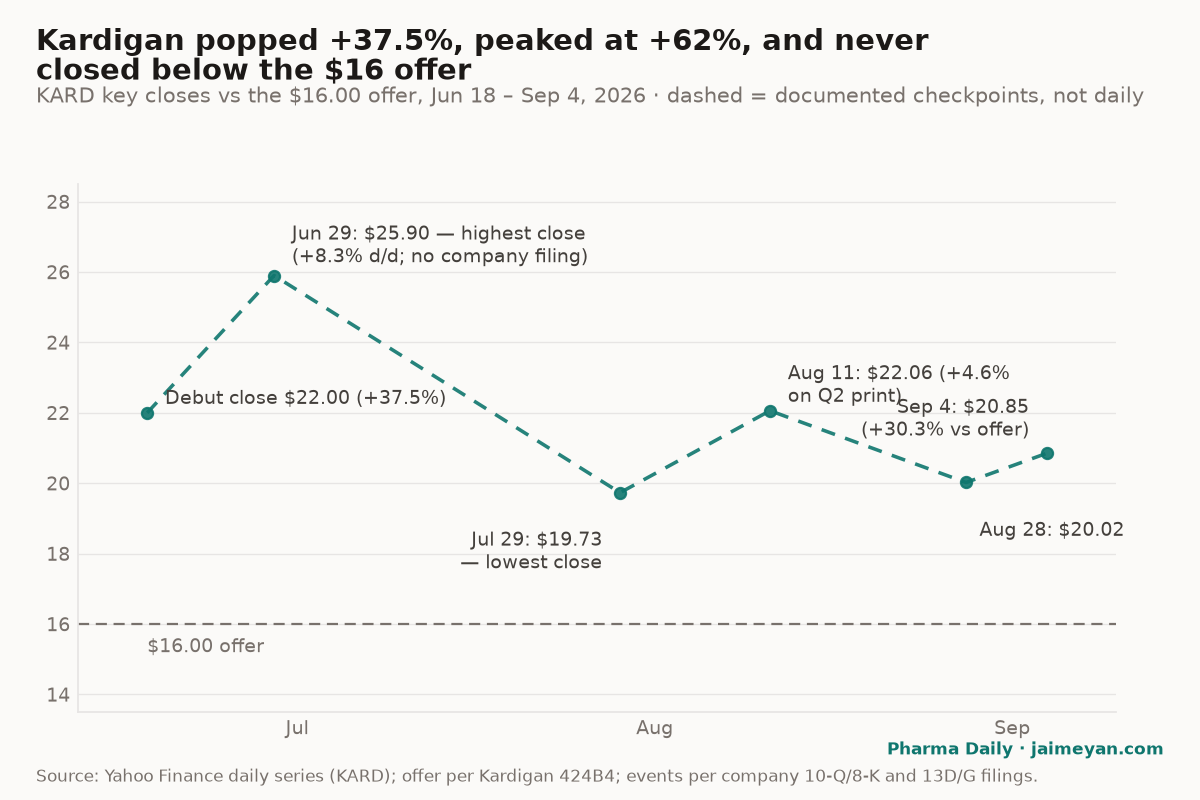
Figure 1: KARD’s documented closes versus the $16.00 offer, June 18 – September 4, 2026. The stock has never closed below the offer price; its post-debut range is entirely between +22.5% and +61.9%. Dashed segments connect documented checkpoints, not a daily series; highest and lowest refer to closing prices, not intraday extremes.
Against the class bifurcation, Kardigan is a middle case with a specific shape: no platform narrative to punish, but no single-asset clarity to reward either. The +30.3% mark as of September 4 sits well below the single-asset winners — Avalyn was +107.7% on the same date — and well clear of the platform losers — Eikon trades below its offer, while Generate sits modestly above it (per its companion post). The tape seems to be paying for operator pedigree and three dated readouts, at a discount for an all-in-licensed portfolio with milestone and royalty overhangs to BMS and Ionis.
What would change the story
- Three readouts, one window (H1 2027): danicamtiv KINSHIP-DCM Phase 2b topline, ataciguat KATALYST-AV 24-week interim, and tonlamarsen KARDINAL-ASH topline are all guided to the same half. The equity story is a cluster, not a sequence.
- KATALYST-AV’s post-IPO expansion to a 1,276-patient Phase 2b/3 raises both the evidentiary bar and the cost of the CAVS program; the 24-week interim is guided to H1 2027, and the registry estimates Part B (48-week) primary completion at August 2028.
- Runway: the prospectus says cash plus IPO proceeds fund operations into 2028; a financing before the H1 2027 readouts would contradict that guidance.
- Insider flow: ARCH filed its 13D in the first eight weeks; further accumulation or distribution by the pre-IPO register is the signal to track.
One Take
Kardigan refines the class bifurcation more than it confirms it. The dividing line in 2026 is not single-asset versus platform — it is dated, credible de-risking events versus undated optionality, and Kardigan prices like the former despite being a three-asset, all-in-licensed portfolio, because the MyoKardia team, a $20M ARCH purchase at the offer, and three H1 2027 readouts give the market a clock to trade against. My conviction is moderate that KARD trades in its current +22.5% to +61.9% band until that window opens, because nothing else is scheduled to move it — no partnership catalyst, no earlier readout, and the largest single-day move so far (+11.8% on September 2) came on no news at all. What I would not underwrite is the premium over Avalyn-style single-asset stories: the milestone stack (up to $265M per product to BMS, $375M to Ionis) and the all-in-licensed structure cap what any single success is worth to KARD holders. Falsifiers: a slip of any H1 2027 readout, a financing before the readouts despite the stated 2028 runway, or Phase 2b danicamtiv data that show the HFrEF troponin signal recurring in the DCM population.
Key takeaways
- Kardigan priced 25M shares at the $16 top of range on June 17, 2026 (upsized 7.1%), and closed the offering June 22 at $460M gross with the full greenshoe; net proceeds were $422.4M per the 10-Q.
- The stock: +37.5% debut close, highest close $25.90 (June 29), lowest close $19.60 (September 1), +30.3% versus offer as of the September 4 close — never below offer.
- All three clinical assets are in-licensed (danicamtiv from MyoKardia/BMS, ataciguat from Sanofi/Mayo via RSF, tonlamarsen from Ionis), and all three readouts are guided to H1 2027.
- ARCH bought ~$20M of the IPO at the offer price per its 13D; no cornerstone tranche was disclosed.
- At $460M the raise is 1.6x the class median, and cash of $660.7M at June 30 funds operations into 2028 per the prospectus — through the entire H1 2027 readout cluster.
FAQ
Is Kardigan a MyoKardia spinout?
No. It is a new company (incorporated as EnCarda in August 2023) founded by MyoKardia’s leadership after the BMS acquisition, and it licensed danicamtiv from MyoKardia — by then a BMS subsidiary — in November 2024. BMS holds milestones and royalties, not an operating stake.
Did insiders buy the Kardigan IPO?
Yes, verifiably: ARCH Venture Fund XIII bought 1,250,000 shares at the $16 offer (~$20M) per its Schedule 13D. No anchor or cornerstone tranche was disclosed in the prospectus itself.
What is the next KARD catalyst?
All three programs report in H1 2027: danicamtiv’s KINSHIP-DCM Phase 2b topline, ataciguat’s KATALYST-AV 24-week interim, and tonlamarsen’s KARDINAL-ASH topline. Nothing material is scheduled before that window.
Sources
First-hand (filings, releases, registry):
- Kardigan Announces Pricing of Upsized IPO (25,000,000 shares at $16.00) — Kardigan IR, 2026-06-17
- Kardigan Announces Closing of IPO and Full Exercise of Underwriters’ Option (28,750,000 shares, $460M gross) — Kardigan IR, 2026-06-22
- Kardigan S-1/A, June 11, 2026 (23,333,334 shares at $14–16) — SEC EDGAR
- Kardigan 424B4 final prospectus (pipeline; license terms; principal stockholders; underwriting) — SEC EDGAR
- Kardigan Q2 2026 10-Q (cash $660.7M; net proceeds $422.4M; greenshoe confirmation; enrollment status) — SEC EDGAR
- Kardigan 8-K, August 11, 2026 (Q2 results release) — SEC EDGAR
- ARCH Venture Fund XIII Schedule 13D (1,250,000-share IPO purchase at $16.00) — SEC EDGAR
- ClinicalTrials.gov: NCT07210723 (KINSHIP-DCM) · NCT07001800 (KATALYST-AV) · NCT07511361 (KARDINAL-ASH) · NCT06864104 (prior tonlamarsen Phase 2) · NCT07771465 (KINSHIP-OLE)
Aftermarket and context:
- The New Biotech IPO Class: Bigger, Later-Stage, and Judged Harder — Pharma Daily (parent analysis; class table and median)
- Kardigan buttons up $400M upsized IPO to power heart drugs toward phase 3 — Fierce Biotech, 2026-06-18
- Kardigan rises in Nasdaq debut after upsized IPO — Reuters via Yahoo Finance, 2026-06-18
Provenance: collected 2026-09-05. Filing figures from the EDGAR documents and IR releases above; prices (debut close $22.00; Jun 29 $25.90; Jul 29 $19.73; Aug 11 $22.06; Aug 28 $20.02; Sep 1 $19.60; Sep 2 $21.92; Sep 4 $20.85) via the Yahoo Finance daily series for KARD. Percentages versus the $16.00 offer are computed from those closes; “highest/lowest close” refer to closing prices, not intraday extremes. Greenshoe exercise is confirmed by the closing release and the 10-Q, not inferred. ClinicalTrials.gov enrollment figures are registry estimates; the company has not reported actual enrollment except to state KINSHIP-DCM Phase 2b is fully enrolled. All performance figures are marked to the September 4, 2026 close and will move with the market.