A subject’s Response (RS) domain records an overall response of Complete Response. Their target lesions shrank enough for Partial Response, non-target disease is Stable Disease, and no new lesions appeared. Under RECIST 1.1, that recorded response is clinically impossible given the inputs that were supposed to produce it. Run the dataset through the CDISC CORE engine or the Pinnacle 21 FDA engine and it comes back clean — not because the rules are badly written, but because no rule in either engine can say it.
That gap is what my CAVE-Onc paper, published in PLOS One, sets out to close.
TL;DR — Domain-scoped rule engines cannot express cross-domain RECIST contradictions. Converting nine oncology SDTM domains into an RDF graph and validating with SHACL-SPARQL shapes plus a small deterministic agent caught all 20 injected contradiction archetypes, where CORE caught 8 and Pinnacle 21 caught 6. Graph validation augments the industry engines; it doesn’t replace them.
Why domain-scoped rules can’t express this
CORE rules execute as vectorized pandas operations over isolated domain DataFrames. Each rule can reference at most one domain or a pre-joined pair. Verifying an overall response requires joining Tumor Results (TR), Tumor Identification (TU), and Response (RS), then applying multi-step clinical logic — a graph-shaped traversal, not a DataFrame filter.
This isn’t a coverage gap you can author your way out of; it’s a structural expressiveness boundary. I measured the boundary directly: of 122 oncology-scoped CORE rules, 85 (69.7%) ported to SHACL with zero expressiveness compromise. The 37 that didn’t fell into exactly two buckets — 31 cross-domain join rules and 6 row-set uniqueness rules. The unportable third is precisely where the dangerous contradictions live.
The two-layer fix
CAVE-Onc converts nine oncology SDTM domains from XPT into an RDF knowledge graph — preserving RELREC foreign keys and expanding SUPPDM qualifiers into semantic triples — then validates in two layers:
- L1 — 111 SHACL shapes: the 85 CORE ports, 8 RECIST 1.1 derivation shapes, and 18 archetype-specific SHACL-SPARQL constraints embedding multi-domain JOINs, temporal comparisons, and conditional existence checks inside
sh:sparqlblocks. - L3 — a LangGraph agent (CaveAgent) for the one task that’s genuinely awkward as a monolithic query: RECIST Table 7 overall-response verification. It runs a deterministic state machine over typed SPARQL tool calls:
sld_change    = query(TR)   # target lesion SLD vs baseline
nt_response   = query(RS)   # non-target overall response
new_lesions   = query(TU)   # new lesion status
expected      = RECIST_Table7[sld_change, nt_response, new_lesions]
if expected != RS.RSORRES:  emit trace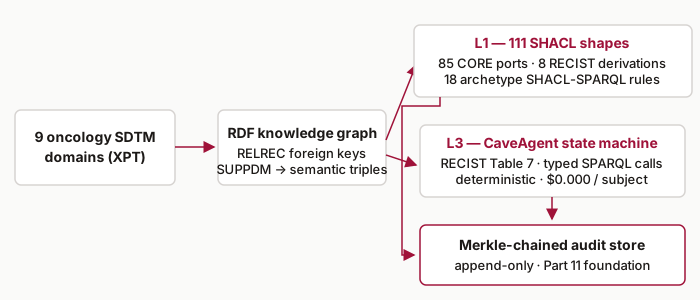
Figure 1: CAVE-Onc pipeline — nine XPT domains become an RDF knowledge graph, then pass through declarative SHACL shapes (L1) and a deterministic agent state machine (L3), with all validation traces written to a Merkle-chained audit store.
Every trace lands in that Merkle-chained, append-only audit store — the foundation for 21 CFR Part 11, though full Part 11 compliance is explicitly out of scope.
What the evaluation showed
The evaluation was pre-registered, in two tracks. Track A (clean CDISC Pilot 1 data, 52 subjects): CAVE L1 and CORE produced nearly disjoint flag sets — Jaccard 0.004 across 5,803 versus 941 flags. Graph validation augments the industry engine; it doesn’t replace it.
Track B injected 20 clinician-reviewed contradiction archetypes into clean data. The split that matters:
| Validator | All 20 archetypes | 10 cross-domain RECIST |
|---|---|---|
| Pinnacle 21 FDA engine | 6/20 | 0/10 |
| CORE engine | 8/20 | 0/10 |
| CAVE L1 only | 19/20 | 10/10 |
| CAVE L1+L3 | 20/20 | 10/10 |
Table 1: Detection of the 20 injected contradiction archetypes by validator — overall and on the cross-domain RECIST subset that rule languages cannot express.
Both industry engines detected only archetypes seeded from CORE’s own rule corpus — and 0/10 of the cross-domain RECIST contradictions their rule languages cannot express (McNemar p=0.002). Nineteen of CAVE’s detections came from L1 shapes; exactly one (A19, the Table 7 contradiction) required the L3 agent.
Why the agent layer earns its place
Why not write A19 as one big SPARQL constraint? I tried. SHACL-SPARQL forbids VALUES lookup tables, so the 34-row Table 7 matrix collapses into a 34-deep nested IF() with zero testable sub-components. The agent encodes the same matrix as a flat 34-row dictionary across 22 unit-testable blocks — maximum nesting 7 versus 34. The maintainability argument is structural, not aesthetic.
The agent path is also fully deterministic: $0.000 API cost per subject, perfectly replayable. That matters in a regulated context — a validator whose output can drift run-to-run can’t sit in a submission pipeline, but a state machine over typed SPARQL calls can.
What I’d warn you about
The manuscript is careful about this, and I’ll repeat it here:
- The 20/20 is a construction validation — the shapes were authored knowing the injected patterns. On five held-out archetypes written after the shape library froze, existing shapes caught 3/5, and only 2/5 via the intended mechanism. Novel contradictions need new shapes.
- The L3 agent was evaluated on a single archetype. Broader agent-layer evaluation is future work.
- The corpus is synthetic. On two real Project Data Sphere trials mapped to SDTM (325 and 227 subjects), the engine stayed specific on unmutated data (0.06–0.09 archetype flags per subject) and detected 10/11 and 16/18 of applicable injected archetypes — but that’s a transfer study, not a prevalence estimate for real submissions.
Three oncology experts reviewed all 20 archetypes: Fleiss’ κ = 0.705, zero rated invalid, though four came back “protocol-dependent” — meaning per-study configuration is a prerequisite for production, not an option.
Key takeaways
- Rule engines like CORE and Pinnacle 21 are structurally unable to express cross-domain RECIST contradictions — both caught 0/10 of them.
- Of 122 oncology CORE rules, 37 (30%) cannot port to any single-domain rule language; those are exactly where dangerous contradictions hide.
- Modeling SDTM domains as an RDF graph lets SHACL-SPARQL constraints express the multi-domain joins that DataFrame-scoped rules can’t — catching 20/20 injected archetypes versus 8/20 and 6/20.
- A deterministic agent layer handles the one constraint (RECIST Table 7) that is unmaintainable as a single SHACL-SPARQL query, at zero API cost per subject.
- The 20/20 is a construction validation, not a prevalence claim: held-out archetypes landed 3/5, so novel contradiction classes still need new shapes.
The deployment model this argues for: keep CORE and Pinnacle 21 enforcing structural conformance, and add graph constraints plus constrained agent workflows for the cross-domain semantic layer they can’t reach. Full details, shapes, and benchmark code are in the full paper in PLOS One.