Before a single line of production code is written, someone authors the mock TLF shells — the tables, listings, and figures that anchor the Clinical Study Report. They must conform to ICH E3 and CDISC ADaM conventions, they are tedious, and they are mostly copy-adapt-paste from precedent. Exactly the kind of work people hand to an LLM. And the first thing you learn when you do: naive prompting produces templates that look plausible but drift off-schema, invent variables, and ignore regulatory conventions.
So I ran the experiment properly. For my PharmaSUG 2026 paper, I benchmarked five generation methods across 1,999 instance-matched bootstrap experiments, spanning 15 templates, five prompt-complexity levels, three LLM providers (DeepSeek, OpenAI GPT-4, Anthropic Claude), and eight therapeutic areas.
TL;DR — Hybrid RAG with reranking beats direct prompting on template quality (85.7 vs. 81.7, p < 0.05), but the effect size depends on the provider — and one provider went negative. An iterative LLM debugging loop then gets 70% of generated R scripts executing within 3–5 rounds, and better templates need fewer rounds.
The setup: five methods, one rubric
All runs used deterministic decoding (temperature 0.1), and template edits were applied as JSON Patch (RFC 6902) operations to preserve schema fidelity. The five contestants:
| Method | What it does |
|---|---|
| LLM_DIRECT | Baseline single-turn prompting, no retrieval |
| LLM_RAG_VECTOR | Standard vector-store RAG |
| RAG_QUERY_EXPANSION | Expands the query first to improve retrieval recall |
| RAG_ADAPTIVE_CONTEXT | Selects and composes context snippets per instance |
| RAG_HYBRID_RERANK | Hybrid lexical + vector retrieval, then reranking |
Table 1: The five generation methods in the benchmark, from bare prompting to hybrid RAG with reranking.
Prompts ranged from L1 (“Create a demographics table”) up to L5 (exception handling, edge-case footnotes, traceability requirements). Templates were scored by five domain-expert LLM personas — clinical researcher, regulatory specialist, biostatistician, data manager, medical writer — on structure fidelity, content accuracy, completeness, format compliance, and variable coverage. To check the rubric wasn’t grading its own homework, I correlated the automated scores against five human domain experts on 250 instances: average Pearson r = 0.895, Spearman ρ = 0.825.
What hybrid RAG buys you
The headline result: RAG_HYBRID_RERANK scored 85.7 on average vs. 81.7 for direct prompting — a statistically significant gain (p < 0.05) on paired, instance-matched bootstrap comparisons (B = 2000, fixed seed 42).
| Method | Mean quality score | Δ vs. direct |
|---|---|---|
| LLM_DIRECT | 81.7 | — |
| RAG_QUERY_EXPANSION | 80.0 | −1.7 |
| LLM_RAG_VECTOR | 83.0 | +1.3 |
| RAG_ADAPTIVE_CONTEXT | 83.1 | +1.4 |
| RAG_HYBRID_RERANK | 85.7 | +4.0 |
Table 2: Mean quality scores across all 1,999 experiments. Query expansion underperformed even the no-retrieval baseline.
Two things worth noting. Plain vector RAG and adaptive context land in between — retrieval helps, but reranking is what separates the top method. And query expansion hurt: on average it scored below doing no retrieval at all.
The effect depends on the provider
The headline number hides real variance. Broken down by provider, with the honest caveats the numbers demand:
| Provider | n | Δ (hybrid − direct) | Cohen’s d | Verdict |
|---|---|---|---|---|
| DeepSeek | 1,644 | +3.5 | 0.415 | Real, medium effect |
| OpenAI GPT-4 | 171 | +10.3 | 0.723 | p = 0.067, misses 0.05 |
| Anthropic Claude | 184 | −6.0 | −0.420 | Negative, not significant |
Table 3: Hybrid RAG’s advantage over direct prompting is not uniform across providers.
The DeepSeek subset is my largest dataset and shows a genuine medium-sized gain. OpenAI shows the biggest gap but doesn’t clear the significance threshold at this sample size. Anthropic went negative — small sample, but I report it as-is. If you’re picking a stack, “RAG always helps” is not a claim this data supports.
Harder prompts, harder templates
Two other findings held up across conditions.
Performance degrades with prompt complexity — from 88.5 at L1 down to 75.6 at L5 in the DeepSeek data — though the hybrid method kept its edge at every level. Keep prompts at medium complexity (L3–L4) where you can.
And some CSR categories are simply harder: demographics was the easiest (85.2), while adverse events (74.3) and safety labs (76.8) were the most challenging. If you’re scoping automation, start with demographics and efficacy, not AE tables.
From template to executable R: debugging converges
A good template is only half the deliverable — someone still has to write the R code. Zero-shot code generation from the templates had a low success rate, so I built an iterative LLM-guided debugging loop:
round = 0
script = llm.generate_r(template)
while round < R_max:               # R_max = 14
    result = execute(script)       # exit code, output file, shape checks
    if result.ok: return script
    script = llm.fix(script, result.error, minimal_patch=True)
    round += 1
Success meant exit code 0, the required output file created, and basic shape checks passing. The results:
- 70% of scripts succeeded within 3–5 rounds, approaching 90% by round 14. (R_max = 14 was chosen because preliminary runs showed it captured over 90% of resolutions.)
- Early-round failures were mundane — incorrect population flags, column-binding errors. Later rounds surfaced subtler, dataset-specific logic mismatches.
- Most usefully: higher-fidelity templates needed fewer debugging rounds. The quality you buy upstream with hybrid RAG pays out again downstream.
That last point makes this a pipeline argument, not just a benchmarking exercise. It directly motivates the four-agent architecture in the paper:
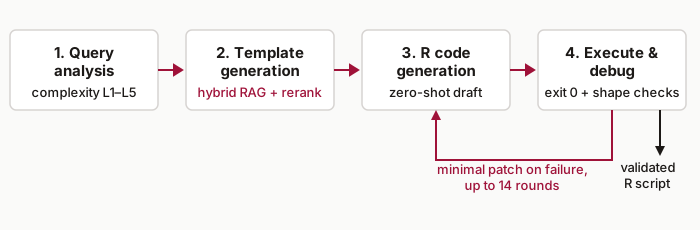
Figure 1: The four-agent pipeline — query analysis, template generation, code generation, and an execution/debug loop that iterates up to 14 rounds.
Limitations I’d flag before you adopt this
The manuscript is explicit about these, and they matter:
- The evaluation used mock templates conforming to standard conventions, not a real regulatory submission pipeline. Company-specific legacy templates are future work.
- Debugging success meant the script executed — I did not validate the statistical content of the outputs beyond shape checks. Human review remains essential in production.
- The debugging loop has a real compute cost at scale; the paper suggests flagging scripts that still fail after 3–4 rounds for human review.
- Even hybrid RAG fails on some L5 prompts where retrieved documents conflict or formatting rules are esoteric.
- The study had no statistician co-author — a limitation the paper states plainly.
Key takeaways
- Hybrid RAG with reranking beat direct prompting on TLF template quality (85.7 vs. 81.7, p < 0.05) across 1,999 bootstrap experiments, while query expansion scored below no retrieval at all.
- The method effect is provider-dependent: +3.5 points on DeepSeek, +10.3 (n.s.) on OpenAI, and −6.0 (n.s.) on Anthropic — “RAG always helps” is not supported.
- Template quality degrades from L1 to L5 prompt complexity, and adverse-event and safety-lab templates are harder than demographics; scope automation accordingly.
- An iterative debugging loop raised R-code execution success from a low zero-shot rate to 70% within 3–5 rounds, and higher-fidelity templates needed fewer rounds — upstream quality pays out downstream.
- Execution success is not statistical correctness; keep human review behind validator gates in production.
The full details — all tables, the paired bootstrap methodology, and the reproducible analysis code — are in the full paper, presented at PharmaSUG 2026, with code at the companion GitHub repo.