The Sep 7–8 collection window produced nine raw deal entries (seven unique transactions), zero FDA approvals, and twelve Phase 2/3 readouts due within 90 days. The pattern is a lopsided dollar total driven by one M&A value-destruction event and one milestone-heavy license.
TL;DR — Seven unique transactions surfaced (from nine raw deal entries), with disclosed totals summing to $14.6B — the headline is dominated by Novartis’s $12B Avidity acquisition, whose lead asset just failed a Phase 3. Monte Rosa’s $2.1B license to Novartis is the next-largest event and sits at the 75th percentile of a thin four-deal historical sample. Zero FDA approvals on a weekday fits the absence-as-signal pattern; the next five sessions are the ones to watch for a catch-up batch.
Deals
| Company | Type | Terms (upfront → total) | vs. history | Source |
|---|---|---|---|---|
| Novartis ← Avidity Biosciences | acquisition | undisclosed → $12.0B | 100th percentile of 4 comps | FierceBiotech |
| Monte Rosa Therapeutics, Inc. | license | undisclosed → $2.1B | 75th percentile of 4 comps | SEC EDGAR |
| Sandoz | financing | undisclosed → $300M | — | Endpoints |
| BrainChild Bio | other | undisclosed → $116M | — | Endpoints |
| — | financing | undisclosed → $116M | — | FierceBiotech |
| Moonwalk | financing | undisclosed → $70M | — | Endpoints |
| Anthropic | collaboration | undisclosed → undisclosed | — | Endpoints |
| Novartis | acquisition | undisclosed → undisclosed | — | Endpoints |
| Central Admixture Pharmacy Services | acquisition | undisclosed → undisclosed | — | PR Newswire |
Table 1: Deal events in the collection window (Sep 7–8, 2026), sorted by disclosed total value. “undisclosed” means the source gives no number — we never estimate.
Comp context: the window’s historical comp base is only four deals (median total $1.55B, thin_sample: true), so the Avidity and Monte Rosa percentiles are directional ranking, not valuation evidence. All upfronts are undisclosed; headline totals overstate near-term cash. Two transactions appear twice in the raw data — BrainChild Bio’s $116M round is reported as both “other” and “financing,” and the Novartis-Avidity acquisition has one value-tagged and one value-untagged entry — so the window holds seven unique transactions (five with disclosed totals, two undisclosed), not nine.
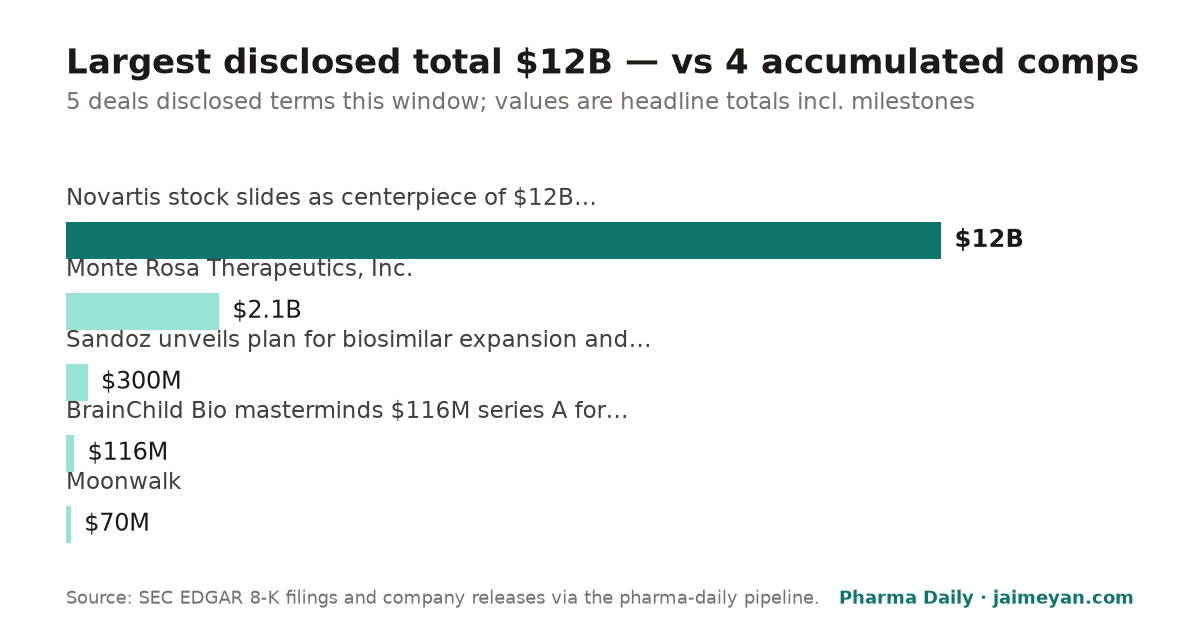
Figure 1: Largest disclosed total $12B — vs 4 accumulated comps (thin base; treat as ranking, not valuation evidence).
Approvals
No FDA approvals surfaced in this window — a quiet agency day that matches the pack’s absence-as-signal pattern.
Readout Calendar
| Primary completion | Phase | Study (sponsor) |
|---|---|---|
| 2026-10-30 | Phase 3 | Encorafenib + binimetinib + pembrolizumab, advanced melanoma (Pfizer) |
| 2026-12-02 | Phase 3 | Ritlecitinib, severe alopecia areata ages 6–12 (Pfizer) |
| 2026-12 | Phase 3 | Thromboprophylaxis in malignancy with central venous catheters (Ottawa Hospital Research Institute) |
| 2026-12 | Phase 3 | NSAIDs vs opioid use for tibia fractures (Major Extremity Trauma Research Consortium) |
| 2026-09-19 | Phase 3 | Fluticasone/albuterol asthma combination (Teva) |
| 2026-12-01 | Phase 3 | GST-HG141, chronic hepatitis B inadequate responders (Fujian Akeylink Biotechnology) |
| 2026-12 | Phase 3 | Dolutegravir resistance management (University of Nairobi) |
| 2026-11 | Phase 3 | Levothyroxine adjunct to hypocaloric diet for obesity (Fundación Pública Andaluza) |
Table 2: Highest-ranked Phase 2/3 primary completions due in the next 90 days (score = phase weight × log enrollment × sponsor factor).
Market Reaction
GLUE — +2.02% on the day (as of 2026-09-08). The modest move is consistent with a back-loaded structure: the $2.1B headline is the maximum milestone cap, with the first $50M trigger tied to the first-patient visit in the Phase 2 study.
One Take
The Sep 7–8 window is defined more by what did not happen than by what did: zero FDA approvals on a weekday, matching the pack’s absence-as-signal insight that quiet days cluster before PDUFA batches. Against that quiet, the two value events are mirror images — Novartis’s already-closed $12B Avidity acquisition lost its centerpiece asset to a Phase 3 failure, while Monte Rosa’s $2.1B license to Novartis is almost entirely milestones, with only a $50M first trigger and a 75th-percentile ranking on a four-deal comp base. That explains why GLUE moved just 2.02% on a headline that looks large. Conviction: moderate. What would change it: a PDUFA catch-up in the next five sessions, Novartis quantifying an Avidity impairment, or disclosure of Monte Rosa’s upfront.
Key takeaways
- Disclosed totals across the five value-disclosed transactions sum to $14.6B; the $12B Avidity acquisition is 82% of that total and sits at the 100th percentile of a four-deal historical sample.
- Every upfront in the window is undisclosed; Monte Rosa’s $2.1B headline carries only a $50M first milestone, so headline totals overstate near-term cash.
- GLUE rose 2.02% on the Monte Rosa news, consistent with a back-loaded, already-priced-in partnership rather than a large upfront payment.
- Zero FDA approvals in the window fits the absence-as-signal pattern; the next five sessions are the watch window for a catch-up batch.
- After deduplicating the BrainChild round (reported twice), the window’s non-M&A financing is $486M ($300M Sandoz + $116M BrainChild + $70M Moonwalk).
FAQ
Is the $12B Avidity deal still worth $12B after the Phase 3 failure?
The acquisition is already closed, so the headline price is fixed, but the Harbor trial failure of del-desiran in myotonic dystrophy type 1 impairs the value of the central asset. Novartis shares fell about 12.5% in pre-market trading following the readout.
Why didn’t Monte Rosa’s $2.1B license move the stock more?
The $2.1B figure is the maximum milestone cap, not an upfront. The first $50M milestone is tied to the first-patient visit of the Phase 2 study in Sjögren’s disease, and the 2.02% one-day move suggests the market had already priced in the Novartis partnership.
What does “primary completion” mean in the readout calendar?
It is ClinicalTrials.gov’s estimated date for the last enrolled participant to complete the primary endpoint. It is not a confirmed top-line data-release date, which follows database lock and analysis.
Sources
- Monte Rosa Therapeutics, Inc. 8-K mentioning license agreement — SEC EDGAR
- BrainChild Bio gets $116M for pivotal trial of pediatric brain tumor CAR-T — Endpoints News
- Moonwalk raises $70M to test siRNA treatment for obesity — Endpoints News
- BrainChild Bio masterminds $116M series A for CAR-T’s pivotal push in pediatric brain cancer — FierceBiotech
- Novartis stock slides as centerpiece of $12B Avidity buyout flunks ‘crucial’ phase 3 test — FierceBiotech
- Sandoz unveils plan for biosimilar expansion and new $300M factory in Slovenia — Endpoints News
- Expanding its biopharma plans, Anthropic looks for a life-sciences dealmaker — Endpoints News
- Updated: Novartis sinks after second disastrous trial failure, this time of Avidity-acquired drug — Endpoints News
- Central Admixture Pharmacy Services Announces Sale of 503B Product Portfolio to Quva Pharma — PR Newswire
- A Clinical Trial of Three Study Medicines (Encorafenib, Binimetinib, and Pembrolizumab) in Patients With Advanced or Metastatic Melanoma — ClinicalTrials.gov
- A Study to Learn About Medicine Called Ritlecitinib in Children Aged Between 6 to 12 Years With Severe Alopecia Areata — ClinicalTrials.gov
- Primary Thromboprophylaxis in Patients With Malignancy and Central Venous Catheters — ClinicalTrials.gov
- Effect of NSAIDs on Union, Opioid Utilization and Pain Management for Tibia Fractures: A Pragmatic, Randomized Controlled Trial — ClinicalTrials.gov
- A Randomized, Double-Blind, Placebo-Controlled Trial on Efficacy and Safety of Fluticasone Propionate/Albuterol Sulfate Combination in Participants 12 Years and Older With Asthma — ClinicalTrials.gov
- To Evaluate the Efficacy, Safety and Population Pharmacokinetics of GST-HG141 in Patients With Chronic Hepatitis B (CHB) Who Have an Inadequate Response to Antiviral Drug Treatment — ClinicalTrials.gov
- Ndovu RCT: Investing the Optimal Management of Dolutegravir Resistance — ClinicalTrials.gov
- Levothyroxine as Adjuvant to a Hypocaloric Diet for the Treatment of Obesity. — ClinicalTrials.gov
- A Study of Ramelteon in Chinese Patients With Chronic Insomnia — ClinicalTrials.gov
- A Seamless Phase II/III, Observer-blind, to Evaluate Immunogenicity and Safety of Chikungunya Virus Vaccine in Healthy Subjects 12-65Years of Age. — ClinicalTrials.gov
- Safety and Efficacy of Dexmedetomidate vs. Midazolam for Procedural Sedation During Medical Thoracoscopy — ClinicalTrials.gov
- To Evaluate the Clinical Study of GS1191-0445 Injection in the Treatment of Hemophilia A — ClinicalTrials.gov
All items above are drawn from first-hand public sources — SEC filings, trial registries, and company releases — collected 2026-09-08. No sources failed in this window. The same source-first discipline is what I apply to LLM agents in regulated programming.