On October 25, 2025, Novartis agreed to buy Avidity Biosciences for $72.00 per share in cash — a 46% premium to the October 24 close of $49.15 and roughly 62% over the 30-day VWAP of $44.42 — valuing the company at about $12.0 billion fully diluted. The merger closed on February 27, 2026, with Avidity’s early-stage cardiology programs spun out as Atrium Therapeutics. Six months in, the scorecard reads: one regulatory filing under priority review, one Phase 1/2 win, and — announced this morning — one Phase 3 failure that took 13.9% off Novartis’s stock in a single session. This is the deal retrospective: what was bought, at what price, and what it says about how big pharma is paying for conjugate platforms.
TL;DR — Novartis paid $72.00 cash for an antibody-oligonucleotide conjugate (AOC) platform with three registrational neuromuscular programs — del-zota (DMD44), del-desiran (DM1), del-brax (FSHD) — and spun the precision cardiology work into Atrium (Nasdaq: RNA), capitalized with $270 million. The 2025 deal ranked second only to J&J–Intra-Cellular ($14.6B) by total consideration. As of September 8, 2026: del-zota is filed and under FDA priority review, del-brax met its Phase 1/2 biomarker endpoint in June, and del-desiran missed the HARBOR Phase 3 primary endpoint (vHOT), with NVS closing at $137.81, −13.9% versus September 4. Avidity carried $1.7 billion in cash and securities into the deal; the platform was never an ADC, and we treat it as the conjugate lane adjacent to ADC consolidation. Performance figures are marked to the September 8, 2026 close; prices move daily.
The context trail is unusually first-hand: Kardigan’s IPO prospectus discloses that its chief legal officer served at Avidity “through and following the completion of its acquisition by Novartis in March 2026” (424B4) — the completion 8-K dates the merger itself to February 27, 2026, with Nasdaq suspension effective March 2.
The asset: an AOC platform with three registrational programs — not an ADC shop
Avidity’s technology is antibody-oligonucleotide conjugates: targeting antibodies that carry engineered RNA payloads (siRNAs and antisense oligonucleotides) into muscle tissue, where RNA drugs otherwise do not reach. It is a conjugate modality in the way ADCs are — antibody, linker, payload — but the payload is oligonucleotide, not cytotoxin. That distinction got lost in much of the deal coverage and matters for the comp set: Novartis was not buying an ADC franchise, it was buying the delivery platform that generalizes ADC logic to RNA. Per the announcement release, the deal included three late-stage programs:
| Program | Indication | Stage at announcement | Status as of Sep 8, 2026 |
|---|---|---|---|
| Del-zota (delpacibart zotadirsen) | DMD, exon 44-skipping | BLA planned for 2026 (accelerated approval) | Filed; FDA priority review granted |
| Del-desiran (delpacibart etedesiran) | Myotonic dystrophy type 1 | Phase 3 HARBOR ongoing | Missed primary endpoint (vHOT); path under review |
| Del-brax (delpacibart braxlosiran) | FSHD | Phase 1/2; cDUX surrogate aligned with FDA | Phase 1/2 biomarker win; Phase 3 recruiting |
Table 1: Program status per Avidity’s announcement release and 10-K, Novartis’s September 8 release, and BioPharma Dive’s June and September reporting. Avidity had never submitted a BLA as of its final 10-K.
The balance sheet Novartis acquired: $382.5 million in cash and equivalents plus $1.3 billion in marketable securities at December 31, 2025, against an accumulated deficit of $1.6 billion, per the 10-K. What did not come over: the early-stage precision cardiology programs (AOC 1086 in PLN cardiomyopathy, AOC 1072 in PRKAG2 syndrome) and the Bristol Myers Squibb and Eli Lilly collaborations, all transferred to Atrium Therapeutics — publicly traded, 1 Atrium share per 10 Avidity shares, $270 million of starting cash, led as CEO by Avidity’s chief program officer Kathleen Gallagher, with Avidity CEO Sarah Boyce serving as board chair.
The deal: terms, timeline, and where it sat in the market
| Term | Value |
|---|---|
| Price | $72.00 per share, all cash |
| Premium | ~46% vs $49.15 (Oct 24 close); ~62% vs $44.42 (30-day VWAP) |
| Equity value | ~$12.0 billion, fully diluted |
| Structure | Reverse merger of Novartis sub into Avidity; SpinCo distribution 1:10 |
| Sign / announce / close | Oct 25 / Oct 26, 2025 / Feb 27, 2026 |
Table 2: Deal terms per Avidity’s October 26, 2025 announcement (8-K exhibit) and the February 27, 2026 completion 8-K.
The timeline ran clean: merger 8-K on October 27, 2025; definitive proxy (DEFM14A) on January 30, 2026; stockholder vote February 26; completion 8-K and Nasdaq Form 25 on February 27, with trading suspended March 2 and deregistration (Form 15) on March 9. Four months, signing to cash — fast for a $12 billion deal with a spin attached.
Where it sat: BioPharma Dive’s tracker ranked it the second-largest biopharma deal of 2025 by total consideration, behind Johnson & Johnson’s $14.6 billion Intra-Cellular buyout in January; October 2025 saw eight acquisitions with at least $50 million upfront, the most of any month in several years by their count. For Novartis specifically it was the largest purchase since The Medicines Company ($10 billion, 2019) and AveXis ($9 billion, 2018), and the third neuromuscular bolt-on after AveXis (Zolgensma) and Kate Therapeutics (2024). CEO Vas Narasimhan’s framing in the announcement: the programs would “unlock multibillion-dollar opportunities” and an “industry-leading pipeline” in neuromuscular disease. The conjugate-lane comps from our own DB sit an order of magnitude smaller: Pfizer’s offload of a shelved Seagen ADC to Medicus Pharma at $12 million upfront — plus $15 million due at the first anniversary — against milestone potential above $1 billion, and GSK’s $110 million upfront license for Hutchmed’s KRAS-EGFR antibody conjugate — evidence that the licensing market prices conjugate-adjacent assets at roughly 1–9% near-term upfront (1.2% for Medicis; 8.5% for GSK–Hutchmed) while Novartis paid control-premium cash for the platform version. Our comp base for full upfront/total splits this window is 2 deals — thin sample, directional only.
The tape: a shrug at announcement, a 13.9% verdict six months later
Novartis stock barely moved at announcement — NVS closed $129.14 on October 27, 2025, −0.9% versus the pre-announcement $130.36 — the market treating $12 billion as an affordable option on the platform. The verdict arrived on the readouts instead:
- June 11, 2026: del-brax met its primary biomarker endpoint in a 90-patient Phase 1/2 in FSHD, reducing the DUX4-regulated biomarker KHDC1L and creatine kinase, per BioPharma Dive.
- September 8, 2026: del-desiran missed the HARBOR primary endpoint (video hand opening time) in DM1, with “evidence of clinical activity” in secondary and exploratory measures; Novartis said it will engage health authorities on the path forward. NVS closed at $137.81, −13.9% versus the September 4 close of $159.99, on 8.5 million shares — 3.4x its prior-week average volume. Jefferies’s Michael Leuchten, who had carried an 80% probability of success and $1.5 billion peak sales for del-desiran (about one-third of the deal’s raw potential, by his math), wrote that the miss “will likely raise questions again about Novartis’ due diligence and [business development] approach.” Read-across sold the neighbor: Dyne Therapeutics, which is developing a competing DM1 therapy on the same hand-relaxation endpoint, fell 22%.
- Atrium (the spin): first documented close $14.75 on February 27, 2026; $11.23 on September 8 — a 23.9% fade from the spin’s first close (range since: $11.18–$16.54).
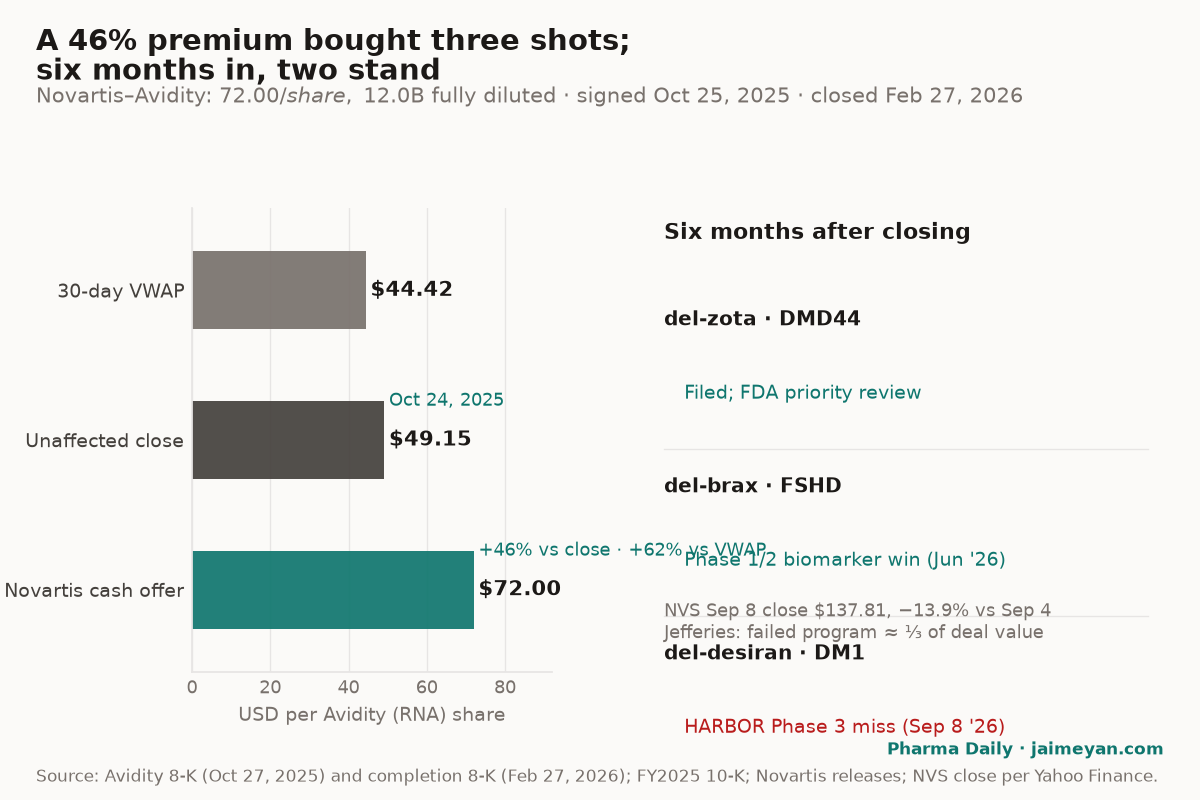
Figure 1: What $72.00 bought — a 46% premium to the unaffected close and 62% to the trailing month — against the three-program scorecard six months after closing. Two of three programs have delivered; the one that failed carried roughly a third of the deal’s modeled value, per Jefferies.
What would change the story
- Del-zota’s priority review: the first FDA action on an AOC would validate the platform’s regulatory path; a CRL would leave the deal resting on earlier-stage evidence.
- Del-desiran’s path: Novartis says it will engage health authorities — either a rescue design on the secondary-activity signal or a wind-down. Leuchten’s note implies investor pressure for Novartis to do more deals, not fewer, after this miss.
- Del-brax’s FDA meeting: Novartis is planning to meet the agency on next steps after the Phase 1/2 biomarker data, with a cDUX surrogate endpoint already aligned per Avidity’s 10-K.
- Atrium’s tape: the spin is the market’s cleanest read on the cardiology assets Novartis declined to buy; a third-party sale of SpinCo assets would trigger the pro-rata cash distribution mechanic in the merger agreement.
One Take
The Avidity retrospective is a study in what a control premium does and does not buy: Novartis paid 46% over the tape — about seven times Avidity’s year-end cash and securities of $1.68 billion — for a portfolio where, six months later, the program carrying roughly a third of the modeled value has failed its first pivotal test, while the two others (a priority-review filing and a biomarker win) are exactly what the prospectus said they were. My conviction is moderate that the deal still clears its cost of capital: del-zota alone was guided to an accelerated-approval filing before the merger, the acquired balance sheet offsets roughly a seventh of the price, and the del-brax surrogate-endpoint alignment is real regulatory progress — but the HARBOR miss converts the narrative from “platform with three shots” to “platform with two shots and an endpoint lesson,” and the 13.9% single-day drawdown says the market has repriced Novartis’s business-development credibility along with the asset. The comp structure matters for practitioners: licensing can buy the same conjugate exposure at roughly 1–9% near-term upfront (Medicus, GSK–Hutchmed), and the spread between those option prices and Novartis’s $12 billion cash-out is the price of control, manufacturing, and the neuromuscular commercial machine. Falsifiers: a del-zota approval without a complete response letter, a credible del-desiran rescue on the secondary-activity signal — or another Avidity-program setback that makes two misses out of three.
Key takeaways
- Novartis paid $72.00 per share in cash for Avidity — a ~46% premium to $49.15 and ~62% to the $44.42 30-day VWAP — for ~$12.0 billion fully diluted; the merger closed February 27, 2026, four months after signing.
- What came over: an AOC (antibody-oligonucleotide conjugate) platform and three registrational neuromuscular programs — not an ADC franchise — plus $1.7 billion in cash and securities at December 31, 2025; the cardiology programs left as Atrium Therapeutics (1:10 spin, $270 million cash).
- Six-month scorecard: del-zota filed and under FDA priority review; del-brax met its Phase 1/2 biomarker endpoint (June 11); del-desiran missed the HARBOR Phase 3 primary (September 8) — NVS −13.9% to $137.81 on 3.4x prior-week volume, with Jefferies pegging the failed program at ~one-third of the deal’s raw potential.
- The deal was 2025’s second-largest by total consideration (after J&J–Intra-Cellular at $14.6 billion) and Novartis’s largest since 2019; the conjugate-adjacent licensing comps in our DB ran $12 million upfront plus a $15 million anniversary payment (Medicus) and $110 million upfront (GSK–Hutchmed) — the cash-vs-option spread is the story for BD teams.
- Atrium, the spin, has faded 23.9% from its first documented close ($14.75 on February 27 to $11.23 on September 8) — the market’s standing appraisal of what Novartis chose not to buy.
FAQ
Was the Novartis-Avidity deal an ADC acquisition?
No. Avidity’s AOCs conjugate oligonucleotide payloads to targeting antibodies — the same antibody-linker-payload logic as ADCs, with RNA instead of cytotoxin. We cover it as the conjugate lane adjacent to the ADC consolidation wave, and the comp set reflects that distinction.
What did Novartis get for the $12 billion?
Three registrational neuromuscular programs (del-zota in DMD44, del-desiran in DM1, del-brax in FSHD), the muscle-targeting AOC delivery platform, roughly $1.7 billion in cash and securities, and a neuromuscular commercial franchise built on Zolgensma and the Kate Therapeutics and AveXis deals. The precision cardiology programs went to Atrium, the spin.
What happens to del-desiran after the HARBOR miss?
Undisclosed beyond Novartis’s statement that it is “evaluating the full HARBOR dataset and will engage with health authorities to determine the most appropriate development path.” Secondary and exploratory endpoints showed evidence of clinical activity, per the company.
Sources
First-hand (filings, releases, registry):
- Avidity 8-K, October 27, 2025 with merger announcement release (terms, premium, SpinCo) and Exhibit 99.1 — SEC EDGAR
- Avidity 8-K, February 27, 2026 (merger completion; Nasdaq delisting; suspension March 2) — SEC EDGAR
- Avidity DEFM14A, January 30, 2026 — SEC EDGAR
- Avidity 10-K FY2025 (cash $382.5M, securities $1.3B, accumulated deficit $1.6B; BLA plans; cDUX alignment) — SEC EDGAR
- Atrium Therapeutics 8-K, February 27, 2026 (SpinCo; Nasdaq: RNA) — SEC EDGAR
- Novartis media release: agrees to acquire Avidity Biosciences — Novartis, 2025-10-26
- Novartis media release: del-desiran Phase III HARBOR update — Novartis, 2026-09-08
- Kardigan 424B4 (Avidity CLO bio; “acquisition by Novartis in March 2026”) — SEC EDGAR
- Medicus Pharma 8-K ($12.0M upfront + $15.0M first-anniversary payment; milestones above $1B) — SEC EDGAR
- ClinicalTrials.gov: NCT06411288 (HARBOR, del-desiran DM1) · NCT07587242 (del-zota Phase 3) · NCT07038200 (del-brax Phase 3)
Analysis and tape context:
- Novartis to acquire Avidity in $12B bet on RNA drugs — BioPharma Dive, 2025-10-26 (deal ranking; October M&A count; AveXis/TMC history)
- Novartis RNA drug falls short in rare muscle disease study — BioPharma Dive, 2026-09-08 (Jefferies POS and peak sales; Dyne read-across; NVS intraday move)
- Novartis RNA drug acquired in $12B Avidity deal notches a trial win — BioPharma Dive, 2026-06-11 (del-brax Phase 1/2 details)
- GSK to license Hutchmed’s KRAS-EGFR cancer drug for $110M upfront — Endpoints News, 2026-09-03 (licensing comp)
- Pfizer offloads scrapped Seagen ADC to Medicus Pharma in up to $1B+ deal — Fierce Biotech, 2026-09-03
- The New Biotech IPO Class: Bigger, Later-Stage, and Judged Harder — Pharma Daily (parent analysis; M&A-to-IPO capital recycling)
Provenance: collected 2026-09-08 via EDGAR (Avidity and Atrium filings, Kardigan 424B4), Novartis media releases, ClinicalTrials.gov API v2, and trade press, with raw dumps under .tmp_research/novartis-avidity-adc-2026/. Prices (NVS closes October 2025 and September 2026; Atrium’s first and latest closes) via the Yahoo Finance daily series; percentage moves computed close-to-close. The 46%/62% premiums are the company’s own computations versus $49.15 and $44.42; del-desiran’s regulatory path beyond “engaging health authorities” is undisclosed. Our conjugate-license comp base for this window is 2 deals with full economics — thin sample, directional only. All performance figures are marked to the September 8, 2026 close and will move with the market.